Monday, March 9, 2009

The Forbidden City


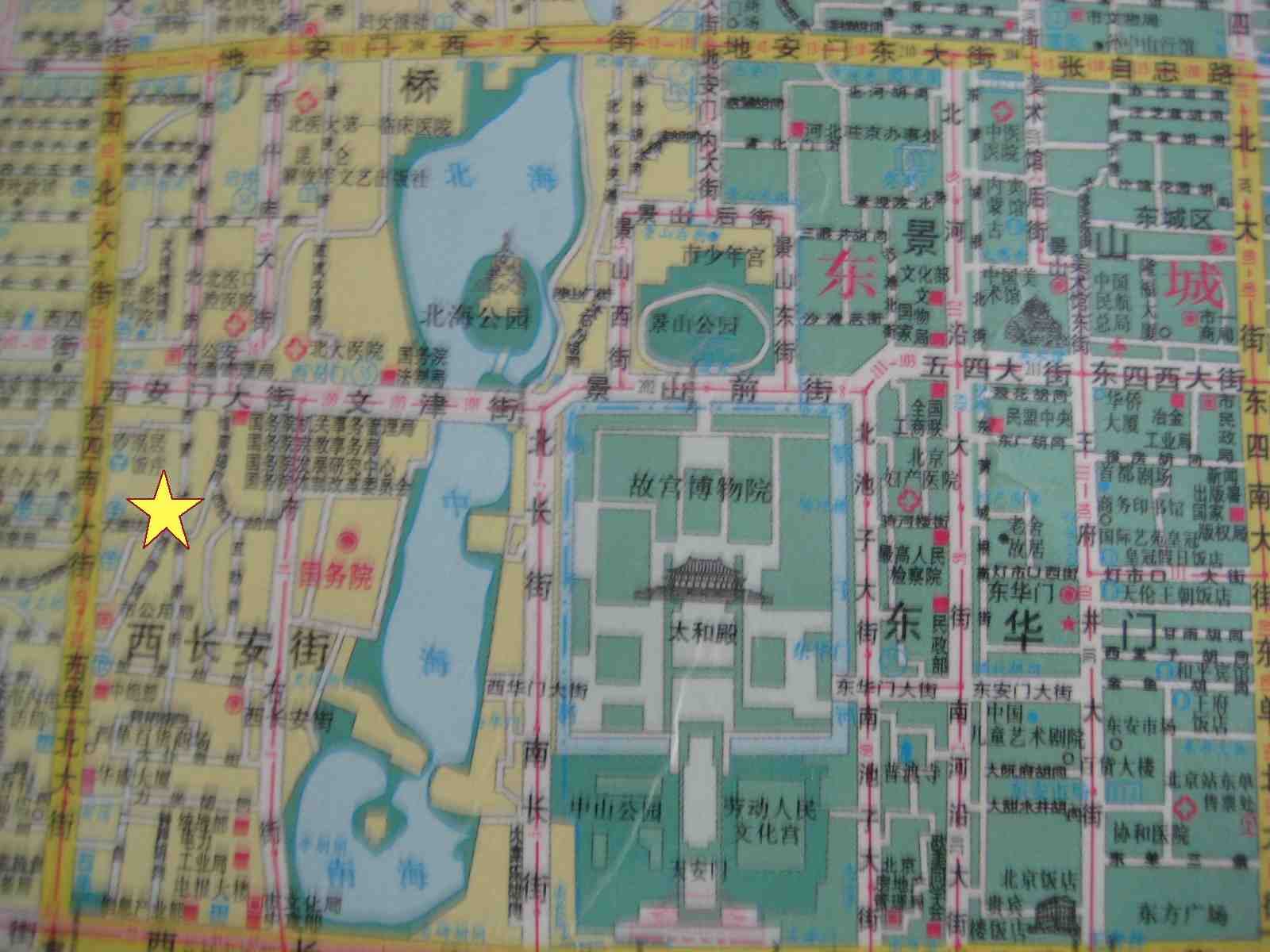
The Forbidden City's a treasure, at least until you get inside and put your face against the grimy windows or try to elbow your way through the unruly crowds to peek at unkempt rugs and dusty thrones. For all the revenue the place brings in (tickets are 40 kuai during winter months and 60 during the summer, though the two gals I was with on Sunday got in at 20 kuai because it was International Women's Day), you'd expect Gugong -- one of the must-sees for every tourist -- to be a little better maintained.

As is, the best parts of the Forbidden City -- rebuilt so many times it retains little of its ancient luster (whatever that might imply) -- might be the large, expansive plazas where one can imagine the ghosts of centuries-old eunuchs and soldiers standing guard for the emperor, and the green mini-park-like section at the north end, full of natural stone formations, mighty cypresses, intriguing junipers manipulated into shapes (mostly the upside-down shape of the Chinese character for "person," 人) and the colors of budding blossoms. I don't remember seeing these parts of the old imperial palace when I last visited as a kid, but I enjoyed the refresher course.

Also enjoyed the translations "made possible by the American Express company." Seriously, this ain't Chinglish:


More pictures:


The ladies of the day, Daisy and Amy.


Touching the tree: these two started it, and soon everyone was doing it; for good reason: it was glossy and smooth, as if the sap had repackaged itself as silk, and stark vertical ravines ran down the sides of the bark as if carved out by hundreds (more!) of years of steady waterfall.


This is what happens when you're not careful with a bag of sunflower seeds: they scatter!


The Forbidden City's back (north) door, from the outside; for pictures of the front door, go here.

POSTSCRIPT: For an insightful read, I recommend Geremie R. Barme's concise volume, The Forbidden City, published last year. Barme, it so happens, is in Beijing for the Bookworm's International Literary Festival.

Sunday, March 8, 2009

Saturday, March 7, 2009

Poet Xi Chuan and musician Bruce Gremo at the Bookworm

At the first night of the Beijing Bookworm International Literary Festival:


The instrument Gremo is playing is called the celia and is apparently the only of its kind in existence in the world. I believe it.

Xi Chuan had his Chinese poems translated into English, which he read with slight difficulty. He paused during one poem to ask Bruce how to pronounce "infinitum," which he pronounced as "in-finy-i-tum." He also had a weird way of pronouncing "mosquito" as "moss-guy-to," but we understood. The mispronunciations actually enhanced the overall esthetic effect, I thought. They were going after a certain mood characterized by unfamiliarity and otherworldliness, and I think it was better that the poet read in an alien tongue (Xi did read one poem in Chinese, however, and that was an enjoyable experience).

I'd like to point out that Xi Chuan's poems were quite dark -- literally, from bats in the night to a poem called "The Darkroom" to lying down at dusk and monsters in the dark -- and that I, despite my illness, was entranced. Will have to buy his books when they come out in English.

Backdated on March 13.

Friday, March 6, 2009

Beijing Bookworm's International Literary Festival

Backdated from March 13


The Nivens, Jenny (daughter, left) and Liz (mother, right)

Opening night tonight and I was sick as a dog. Just horrible timing, but I'm looking forward to attending more events as the festival goes on.

But seriously: terrible timing. I didn't get to talk to the lovely hostesses, Alex Pearson and Jenny Niven, or any of the readers -- Blake Morrison, Liz Niven, Justin Hill -- or the blogger I recognized, Lijia Zhang, or Pallavi Aiyar and Zachary Mexico and, well, you get the drift... anyone. My friends had fun though.

Thursday, March 5, 2009

Picture of the day: more evidence of New China


A mural on the ground floor of the shopping complex at Sanlitun, in a lonely hallway leading to the bathrooms.

Wednesday, March 4, 2009

A reason for optimism?

CNN on the China National People's Congress:

The delegates will represent China's central leadership, the military, every province, including minority groups such as Tibetans, and overseas Chinese.

Landmark social security legislation will be considered that would make health care, unemployment and retirement benefits universal. If implemented, it would mark a major change in the nation's social welfare system.

Tuesday, March 3, 2009

The Science and Technology Museum


Through a family connection, a department head in the space and aeronautics division of the Science and Technology Museum (he's a researcher, not curator) gave us a brief tour of the space exhibit, with real satellites hanging from the ceiling and other gadgets that are fully operational (we were told they're the backups, making this place the sideline of China's space program, I suppose).

I bring this up in light of Time's article last week about China's space program. The country has already helped countries like Brazil put satellites in space, and now it wants to be bigger player on this front. For $40 million -- half the price the Americans, Europeans and Russians charge -- China can put a commercial satellite in space, and if the country's latest venture is successful, it would indeed be, as Time puts it, "a major leap forward."

Of course, you can't have a story without your stock Chicken Little quote from Yet Another Concerned Congressman:

Not everyone sees it that way. Addressing the House of Representatives Science and Technology Full Committee on Wednesday, Republican Congressman Dana Rohrabacher stressed that any rule revision must ensure "nations who proliferate weapons of mass destruction and rogue nations are barred from receiving our high-tech systems."

Chief among "such places is the People's Republic of China," Rohrabacher continued, issuing a warning against firms seeking to sidestep restrictions in order to do business with Beijing. "Eutelsat sells tens of millions of dollars' worth of satellite services to the U.S. government through DISA [Defense Information Systems Agency] contracts. Clearly, this is the beginning of a game of chicken between Eutelsat and the Obama Administration."

Monday, March 2, 2009

A friend sent me this article with the comment, "Maybe this is why you can't get a girl"

I was sitting with a group of Chinese girls at a company dinner party on Friday when I was asked, "Americans aren't used to the way we tease each other, are they?" This was preceded by one of them looking around the group and saying, "You look Korean" (not a nice thing to say in this country, usually); "You look Japanese" (not an insult, believe it or not); "You look... you know, you really do look Filipino." The girl she said this about blushed and replied, "Thank you."

For the uninitiated, it can really be quite jarring how bluntly the Chinese talk about appearances and race, the generalizations and stereotypes they never bother questioning. I won't list examples here, but for those who think the Chinese only do this to other racial and ethnic groups, think again. They're just as blunt -- more so, even -- when talking about themselves.

From an article titled, "Listen up, guys! First impressions do count," about why Chinese men are unable to attract Western women:

Here is a piece of advice for Chinese men trying to land a date with a Western woman: Start looking in the mirror.

That is because Chinese men are physically less appealing than their Western counterparts and have more difficulty trying to attract foreign women, according to psychologist Zhang Jiehai from the Shanghai Academy of Social Sciences.

Jock-shock article? Humor website? Nope. Try China Daily.

One more:

Sports will make you masculine and can also work as a common interest between you and the woman, Zhang says.

Apart from sports popular in the West like rock climbing, bungee jumping and baseball, Zhang strongly recommends Chinese kungfu and taichi, aspects of Chinese culture in which many Western women are interested, to increase your charm.

I'll open this up for a vote: what should my response be?

POSTSCRIPT: There's a mention of Chinabounder within the article, a Western blogger who bragged about his sexual exploits with Chinese women in explicit detail and then got hunted down by a Chinese Internet lynch mob that turned into a real lynch mob, forcing him out the country. Then he returned with a book.

Well, here's an eyebrow-raising sentence from our friends at China Daily: "News agencies later reported that the blogger was actually a group of performance artists."


I applaud slowly, with one hand, bemused.

Sunday, March 1, 2009

Happy birthday to Nainai


Nainai is second from the right

It's been a while since I've mentioned her in this space, but my grandma -- paternal, so nainai in Chinese -- recently celebrated her birthday in Beijing, attended by a group of 25 or so family and close friends. She doesn't like us calling it a birthday celebration -- no one in our family celebrates birthdays; my dad's was last week and I don't think anyone sent him so much as an email -- and probably won't like me revealing that she's 81 years old, but she doesn't look it. "We'll celebrate her birthday when she truly gets old," my dad said.

Basically, we used the occasion to have a family meal, complete with moutai -- the real stuff.


Reflected off the ceiling


A sampling of our meal:


Down the rows from left to right: Chicken, duck, lamb, fish, pork, fish's head, zucchini (I think) with mushrooms, assorted veggies with meatballs of unknown meat

Happy birthday, Nainai.


POSTSCRIPT: My cousin Zhang Peng and Anqi are married! The wedding will come later, but they officially registered themselves as husband and wife last week in a registration office of some sort for 9 RMB. We toasted them at our lunch, then Zhang Peng proceeded to drink way too much moutai.