Monday, January 9, 2012

Your Heart of Beijing China blogs, 2012

Beijing/China blogs: ROLL CALL TIME.

I recently did some much-needed housecleaning of this site's blogroll, which appears on the sidebar to your right. As I've stated before, these sites are roughly ordered by my preference, though the order breaks down a little in the categories following "Blogroll - News and Issues."

New to the blogroll is an "in memoriam" section: blogs that have been dead for a while (as I just noticed), like an unfed goldfish. These are all News and Issues sites that were notable for one reason or another, and that could not be sustained -- for one reason or another. They can be found after the "News and Resources" section.

It's unfortunate that china/divide, undoubtedly one of the Top 10 China blogs in existence for about 12 months from 2010-11, heads that "in memoriam" section. So it goes.

But china/divide wasn't the only site that dropped out of this blogroll's Elite Eight category. Danwei, which apparently is now a "web magazine" that has a new domain (.com, no longer .org), has been relegated to the second tier due to lack of posts. Sorry, Jeremy. I know it sucks being blocked by the Great Firewall, but you do know you're transitioning to the dark side with this whole "custom research" thing that you're selling, right? To each his own, I suppose. (Check out Danwei's blogroll while it's still free to access.)

Taking those sites' places: please welcome China Geeks and Dan Harris's consistently excellent China Law Blog.

A few words about some News and Issues blogs:

Some sites would be much higher if the owners would post more. Brendan O'Kane, looking at you.

China Government Watch is now a private blog for "invited" readers only. If anyone from that site is reading this: PLEASE INVITE ME. Seriously. I want in the club. How do I get in?

Completely new to the blogroll is Sinocism, which is good, but sometimes it's too much, you know what I mean? Just pure unfiltered info dump.

I don't know how often I will update the blogroll rankings. Maybe quarterly? Monthly? Whenever I have time.

The rankings under the Life category are a bit less thought-out. Let's just say that after Jenny Zhu's site, I'm not sure if anything listed is actually extant. Assume no. I really should just delete all of them, but I kind of like to keep 'em for posterity.

New under this category: Laowiseass, a guy in Taipei. How's this for a throwback: he uses Livejournal. Everything's different in Taiwan.

Some sites have moved. Don't try to access the old Beijing Sounds (北京的声儿) site. Here's the new URL.

The "art, literature, music" section has been renamed "Culture." The blogs that belong to magazines and newspapers -- i.e. traditional media -- is now simply "Media."

Here are four new tech blogs that really aren't my thing, but have at it if you like: Silicon Hutong, Tech Rice, DigiCha, TechNode.

I'm going to try to get into the habit of reading less Deadspin and more of my RSS feeds, which include all the sites on my blogroll and then some. I'll link to stories that don't suck. Let's say we'll do this every... Friday. Happy reading.

Sunday, January 8, 2012

A non-basketball observation amid the Ducks' current slump

After its 109-105 loss tonight to Fujian (12-9), Beijing's basketball team has now lost seven of its last eight, including four in a row at home.

It's gotten to the point where the losses are no longer surprising. But with each one, we're forced to ask a bit more incredulously: how the fuck did this team start 13-0?

They started 13-0.

And now they're 14-7, three games behind first-place Guangdong.

The Ducks played lousy basketball tonight. I can't say it any nicer than that. They trailed for basically all but 30 seconds. They couldn't rebound on the defensive end and they couldn't make shots -- we're talking layups and uncontested three-pointers -- when it mattered. The final score would have been a lot more lopsided had it not been for some garbage-time three-pointers.

***

This might not have been the story of the game (the story of the game is how much Beijing's "big men" absolutely, positively suck), and it might not even be indicative of anything significant, but the image I take away from tonight came in the middle of the third quarter. With a bit over nine minutes left, the Ducks called a timeout after going down by 11. On the bench, Stephen Marbury and Randolph Morris, Beijing's two foreign players, sat while everyone else stood around head coach Min Lulei, who took a knee on the court. He said things like, "Where is ___? Is he here?" He scrawled something on a mini-white board. "Look, if you don't get it the first time, you can try again. Okay? Add fuel, add fuel." Then all the Chinese players, standing around the coach, put their hands into the middle for a team cheer.

Marbury and Morris sat and did nothing. Nothing at all. Not comprehending a thing, nor wanting to. Just passing time.

Again, the scene may not be indicative of anything other than how spoiled the CBA's foreign players are (believe me when I tell you: no one expects foreigners to put their hands in for a group cheer among their lesser Chinese teammates, who not only play lousy basketball but are paid less and berated more by coaches and referees [yes, refs give foreigners preferential treatment], and are expected to actually follow coaches' orders). And in the interest of fairness, I should point out that Marbury has been having a really good season. Morris sometimes makes himself useful, too.

Still. Way to act like schmucks, guys.

Gary Locke said at a recent event for American study-abroad students -- as part of Obama's 10,000 Strong Initiative, I believe -- that while he might be the ambassador to China, it's "you" who are the everyday ambassadors for America. I wish more expats here would take that sentiment to heart. Because willy-nilly, foreigners here do represent something greater. While the Chinese have come a long way in their attitudes toward laowai (literally, "old outside") or yangren ("ocean people" -- basically another way of saying folk who don't belong), to differing extents, foreign cultures are still generally perceived through prejudiced lenses. Chalk it to culture or whatever, but the result is that every small action really can go a long way toward dispelling or reinforcing stereotypes. Doing shit like hectoring a streetside vendor matters. Waiting patiently in line matters, even if you don't know it (I've overheard parents say to their children, "Look at so-and-so, that's how you should behave"). Helping an old lady cross the road: yeah, you bet that makes an impression. Young people here think of just that type of act -- a small bit of goodness when no one expects it and when no reward is expected -- as the perfect example of something called "everyday heroism," this in a society that rather lacks heroes and role models.

I've gotten off on a tangent. I'm just trying to say: it's quite unfortunate that America's basketball ambassadors to Beijing can't act the part.* I wonder if Marbury's still tweeting about "love."

*Look, I understand why they may be miserable. They're in a strange land trying to do just one thing and they can't do it well because they're surrounded by incompetence, from facility managers to referees to teammates to coaches. I can't help thinking though: if you don't like it so much, get the fuck out. God forbid you feel entitled doing one simple thing like playing basketball.

POSTSCRIPT: I think one of the Beijing TV commentators -- actually commentating courtside, which is rare because most of the time they work in studios while watching the games from their corporate-sponsored laptops -- called Morris's girlfriend "hot." My sincerest apologies if I misheard the Chinese word "re" or am mistranslating it, but he definitely commented on the girlfriend, who was briefly shown on camera. Here she is, for whatever it's worth:

Saturday, January 7, 2012

Review of Flowers of War [金陵十三钗]

The first thing I'll say is that it was a good movie. Not being a movie critic, I shouldn't need to say much more. It has a truly fantastic story, a tremendous cast (Zhang Xinyi turns in the best performance as 13-year-old Meng Shujuan [this Zhang, thankfully, is not 13], though Christian Bale also does his thing and shows everyone that he doesn't need world-class lines to be a world-class actor). Go see it.

But...

Here, allow me to say that if you don't read the rest of this post, I won't blame you. You should just go see the movie. But if you insist on staying...

...it was a good film that was good enough for us to all get glimpses of how it could have been great. And it was not great. And because it wasn't, I can't help feeling a bit let down, even though, truth be told, the film surpassed my expectations.

Is that possible? To be simultaneously satisfied and disappointed?

A friend who left the theater with me commented that this was a "very Chinese" film. But I have to disagree. It's "slightly" Chinese, I'd say -- if anything, it tries to resist being the classic "Chinese" epic (will explain soon). This film, after all, is China's hope to win an Oscar in the Best Foreign Language category precisely because it tries to be Hollywood. We end up with a Chinese/Hollywood hybrid, and it's good, it's fine, but -- at the risk of repeating myself -- it doesn't fulfill its potential.

Let's define what it means for a film to be "Chinese." Watch enough movies made here that authorities insist on calling "epic" and you'll see some recurring characteristics. (Apologies for these generalizations.) There has to be a moral. There has to be a Manichaean divide between good and bad, nothing in between. There has to be a weepy, faux-emotional scene -- or like four or five. There is usually enough histrionics to put a Peking Opera singer to shame. There has to be endless explication, so that "the point" falls off a roof and whacks you in the head, at which point you look up and see a movie stagehand wave both arms and go, "And here's the point, in case you missed it...!"

To that end, Flowers of War was sparing -- and that's an accomplishment. This was a Chinese production about the Rape of Nanking. It featured pre-adolescent girls who spend a third of the movie crying, and obvious foil characters in the form of prostitutes. It was a war film with "flowers" in the title. Do you realize how disastrous this movie could have been? Here, read this excerpt of an essay that the lead actress, Ni Ni, wrote about her character Yu Mo:

I Yu Mo, am in love with this man. I know my love probably won’t survive, and I do not want to drag him down. I hope he can have calm and happiness … tonight, I am the most pure Yu Mo, most tolerant Yu Mo, the most lovely Yu Mo, the most real Yu Mo … I want to enjoy this short encounter, treasure every minute and every second in my mind.

Ni turned in a solid performance, but if she were under the direction of a lesser production team -- perhaps John Woo of Red Cliff fame -- do you realize how badly this could turned out?

Flowers isn't your classic contemporary Chinese epic. There are many scenes that were cut at just the right moment, before it crossed over into the cloy or arch. But -- and here's what I mean when I say Flowers could have been better -- there were a few times when I wished another editor could have looked at a scene and said, "You know what... too much."

But the people behind Flowers have studied Hollywood, and they generally know what works. (We'd do well to remember that this movie, a shoo-in for a Chinese Oscar, was made to impress the judges on the Academy of Motion Picture Arts and Sciences panel; SPOILER ALERT, CHINA: Flowers isn't going to win; if it does, it's because someone was bought off.) There's romance that's halfway plausible (despite what Ni Ni writes, it's not love; sorry, it's not, and it's better because it's not love); there are Japanese characters who are not all evil; there is this incredible scene -- and I don't think I'm giving too much away, but I'll sound the spoiler alert anyway -- this short dream sequence envisioned by the girl Shu where prostitutes are dressed in colorful gowns and saunter toward the camera while singing the most poetic music (undoubtedly the best scene in the film). (Incidentally, Chinese viewers may be turned off by all the above; sex in a movie about the Rape of Nanking? Unthinkable!) It's all good, quite good -- but it's all very derivative, not exactly hackneyed, but imitative nonetheless.

Now, we should point out that it's a good imitation of a good Hollywood film, and that's nothing to be ashamed of -- after all, there's a reason the term "Hollywood film" exists: because there is a mold, and oftentimes writers and directors are judged by how well they conform to that mold while disguising the mold from the audience. It's all sleight of hand, this "magic" of moviemaking. But the problem is, because Flowers is a Chinese film -- or is supposed to retain elements of Chinese-ness, given that it's a government organ that supplied the $90 million to make this flick -- it gives itself away a bit more easily than it might have otherwise. We see the gears churning and the imperfect seams. It's impossible for me to cite examples without spoiling the movie any more, so here I'll just repeat: go see it; what I'm saying will be self-evident.

Flowers is good despite its imperfections, yet I can't help wishing that it were good because of them. I wonder what a less canonical but better director, someone like Jia Zhangke, would have done with this material (though really, who knows how he or anyone else would have been warped by the $90-million budget).

One last thing: This film inevitably will be compared to Schindler's List. I'm not going to google this, but I'll bet my last drop of intuition that it's already been called "China's Schindler's List" by someone on the Internet. Regarding this, please allow my one observation:

Schindler's List built up to its emotional climax; just when it seemed like the film might let you, the moviegoer, slip out of its black-and-white reality without bawling like a baby, you got hit by that scene. You know the one. There's ample risk building a movie toward one breathtaking climax, but a master of the craft like Steven Spielberg can pull it off.

Flowers wanted that kind of emotional payoff, but it wasn't willing to push all its chips into one moment. Instead, it hit you with several moving, heartrending scenes -- scenes that, from what I could tell, wanted you to cry -- scenes that were good, and that really might make you cry (seriously, be prepared for that), but by the end, the accumulation of these psychic blows might leave you feeling something of emotional fatigue. We aren't able to bear more. As in, we're not as invested as we could or should be. And that's too bad, because to the very end, I really wanted to invest more -- call that a credit to the film, one that tries earnestly and should be rewarded for its effort.

And now -- in case you didn't click on that first link -- Zhang Xinyi, again:

UPDATE, 1/14: Thanks to those who have written in to point out that 13-year-olds don't have breasts that look like the above.

Thursday, January 5, 2012

Which of these Republican presidential nominees knows what's up in China?

Let's play this game. All pull quotes from Wall Street Journal.

Is it Mitt Romney, the suave asshole who exercises with a shake weight?

...has taken a leaf out of Obama’s 2008 playbook with a promise to get tough on China’s trade policy. Day one of a Romney administration would threaten countervailing duties against Chinese imports if Beijing didn’t move quickly to float the yuan.

Is it Rick Santorum, that social conservative? (Further insults gratuitous.)

...He says that China should be challenged on religious liberty and the U.S. should be doing more to support human rights activists.

Is it Ron Paul, that lovably losing idealist? (Idealistic losing lover?)

...His promise to boost the dollar’s strength and reduce America’s foreign-policy entanglements could give China a freer hand on the exchange rate, and to flex its foreign-policy muscles in the Asia Pacific.

Or is it this guy?


As the former U.S. ambassador to China, he is the candidate with the most sophisticated views, arguing that the reality of Beijing’s own politics makes confrontation on the exchange rate unhelpful.

Good luck in New Hampshire, Governor.

Moral situation, moral situation, moral situation

Communist Party policy magazines are a hoot. On the heels of Hu Jintao's comments, there's now this latest (as reported by Global Times)...

The morality situation in China has been improving, according to an article published in Qiushi, the Communist Party of China Central Committee's flagship magazine devoted to policy-making.

Pray thee, tell.

"The reason for the hesitation in helping strangers is that the Chinese traditional culture of 'social acquaintance' is transforming into a 'strangers' society' culture, while the system of social controls and curbs is weakening," it said.

The "strangers' society culture" bullshit is just bullshit that is meaningless, because it is bullshit. The phrase "system of social controls and curbs is weakening" is worth perhaps a second of your attention, because who the fuck needs a healthy blood pressure? Let it spike through my ears, I say.

In summary: Chinese are reluctant to help strangers in need because the system of social controls and curbs is weakening.

Not because of, say, lazy judges who are more concerned about clearing their dockets than actually weighing goddamn evidence, thus setting a legal precedent that has a real effect on the choices that citizens make -- because fuck if a judicial decision in NANJING affects people elsewhere. Not like the Internet does shit like transmit INFORMATION.

Anyway, "social controls" -- maybe I understand what that means: something like a Good Samaritan Law, the kind that took the Seinfeld gang off the air. I wouldn't have chosen the phrase "social controls," but hey, potato, potahto. Perhaps a law is necessary to get people to behave a certain way, a more "moral" way.

But "curbs"? Like...

...

Fuck it, you mean censorship. You mean Chinese people have too much fucking freedom to fuck around and make fucking money and fantasize about fucking Western women and fuck if they care about some old dude dying on the street.

This is what you mean, because you're fucking idiots. Witness:

"The heated discussion of a morality crisis and the condemnation of immorality just reflect the public's great desire for a better moral situation," said Cai [Xia, professor within the Party School of the CPC's Central Committee], adding that as the main part of society, the people's thought represents that of society, therefore it is reasonable to say the moral situation in the country has been improving.

"In the age of moral pluralism, officials' and Party members' positive exemplary roles are needed to guide the public," she said.

And now, Sir Walter Raleigh, to cleanse your brain:

A Description of Love

Now what is love? I pray thee, tell.
It is that fountain and that well
Where pleasure and repentance dwell.
It is perhaps the sauncing bell
That tolls all into heaven or hell:
And this is love, as I hear tell.

Yet what is love? I pray thee say.
It is a work on holy-day;
It is December matched with May;
When lusty bloods, in fresh array,
Hear ten months after of the play:
And this is love, as I hear say.

Yet what is love? I pray thee sain.
It is a sunshine mixed with rain;
It is a tooth-ache, or like pain;
It is a game where none hath gain;
The lass saith no, and would full fain:
And this is love, as I hear sain.

Yet what is love? I pray thee say.
It is a yea, it is a nay,
A pretty kind of sporting fray;
It is a thing will soon away;
Then take the vantage while you may:
And this is love, as I hear say.

Yet what is love, I pray thee show.
A thing that creeps, it cannot go;
A prize that passeth to and fro;
A thing for one, a thing for mo;
And he that proves must find it so:
And this is love, sweet friend, I trow.

Wednesday, January 4, 2012

Easier said than done, Mr. Hu

This latest from the New York Times is about President Hu Jintao's comments regarding soft culture. Apparently China is losing the battle to the U.S. (This is where you put on your best "Gee, really?" quizzical face. Do you raise an eyebrow? Do you pout your lips and slowly nod? Do you throw both hands in the air, scrunch up your neck and gape?)

According to the article (emphasis mine):

“We must clearly see that international hostile forces are intensifying the strategic plot of westernizing and dividing China, and ideological and cultural fields are the focal areas of their long-term infiltration,” Mr. Hu said, according to a translation by Reuters.

“We should deeply understand the seriousness and complexity of the ideological struggle, always sound the alarms and remain vigilant and take forceful measures to be on guard and respond,” he added.

Those measures, Mr. Hu said, should be centered on developing cultural products that can draw the interest of the Chinese and meet the “growing spiritual and cultural demands of the people.”

Spiritual demands.

Here is a country whose spirituality is that of commerce. It's a place where an injured lady can libelously sue the person who helped her, win the case, and see the legal fallout create a dystopia-like scenario in which people avoid helping strangers unless the incapacitated peeps, "It is not anybody's fault. I fell by myself."

This is the society we're dealing with, the one that Hu Jintao wants to rescue from the minor-key tunes and mild electro-synth grooves of Lady GaGa, lest China loses the rights to the zeitgeist of the 21st century.

Pop and entertainment, something the rest of the world sees as, well, pop and entertainment, i.e. mostly inconsequential, served best for leisure and diversion with a cocktail, is politicized by China's top leader as a thing to be "on guard" against and "respond" to. (Remember all those automaton responses to political questions during the Olympics? "Don't mix sports with politics..." Apparently pop and politics is not a problem though!)

If Hu wants to fight a culture war, his side will be massacred. The U.S. is -- I'll borrow a phrase the Chinese are fond of using -- a developed country, which means its people have the time and resources to be creative. In China, on the other hand, untold millions are just trying to scrape out a living, while millions more are caught in the rat race, and millions more are dealing with the day-to-day management of ambition vs. happiness, work vs. family, making the difficult choices those in Suburbia, USA can't imagine, not asking "Could I love him?" but, "Should I risk getting sued and help this dying man?"

But amid this backdrop, China is not a place that, despite its leaders' best efforts, only produces mindless drones and grubs in lockstep. I see this populace's resilience every day: normal working people who dare to call bullshit on the propaganda they're peddled. And it's not just me who sees it: you do too. China is a place that has produced intellectuals such as Gao Xingjian, who confronts his personal past to save his country's soul; courageous people like Chen Guangcheng, the blind lawyer whose story could be a Hollywood movie; people for whom the struggle is not between nations but much simpler, between individuals: a struggle for answers to confirm our humanity.

There are people, in short, able and willing to produce real culture, the kind you would write home about, to question spirituality or create it, to do something people actually care about. Pardon the cliche, but theirs is art as mirror for life.

And what, you ask, becomes of people like them? They are exiled. They are crippled and imprisoned. They are gagged. They are censored.

(Meanwhile, China's most well-known "pop" writer playfully acts the part of a self-aware troll.)

Chinese officials believe the way to the public's heart is through "socially responsible" TV shows. As it concerns the Chinese public, they're not completely wrong -- hey, I have older relatives who are socially conservative. But if that's what the authorities want, they should stop fooling themselves about the culture "battle," that there even can be one. They've lost. It's over. They can't even save face by banning Western culture, because it's one thing to censor a New York Times article, it's quite another to tell a 19-year-old in the club what kind of music should excite them.

So here's a proposition: that we not search for China's version of Lady GaGa -- indeed, Chinese people like America's GaGa in part because she is as American as they come, with all those implications -- but search for ways to create a society that will make the question Whose culture is better? irrelevant.

China's leaders have made a deal with its constituents: stay out of politics and we'll stay out of your lives. I think it's time for our counteroffer: you can stay in power if you stay out of art and culture. Otherwise, we have nothing.

Friday, December 30, 2011

What's up, Ducks?

Beijing's professional basketball team, after winnings its first 13, lost its third straight game Wednesday night -- all at home -- to drop into a first-place tie with eminently hatable Guangdong. The Ducks surrendered a huge lead against Zhejiang Guangsha to lose 118-112, squandering a great performance by Stephon Marbury -- the China Daily columnist -- who, best I can tell, was not stoppable. He scored 34 points on 15-for-24 shooting and was credited with 9 assists, but who knows how many he'd had if the CBA weren't notoriously bad at tracking assists.

But he was outdone by one Wilson Chandler, one of the three Denver Nuggets players who elected to sign with the CBA during the NBA lockout, who scored 44 and grabbed 18 rebounds. Those are, indeed, eye-popping numbers, but Guangsha also got remarkable contributions from Puerto Rican big-man Peter John Ramos, who went 26 and 14. Ramos, in the minutes I saw of him, sealed his spot in my heart as least likable basketball player in the world, with his scowls, his complaints, his uninterested demeanor, his sleepwalking up and down the court, and the elbows he threw after every rebound attempt. The man does not look happy to be alive when he's playing basketball.

POSTSCRIPT: Unsurprisingly, Chandler was selected player of the week. Eurobasket also reports: "Guangsha L. will need more victories to improve their 12-4 record."

Thursday, December 29, 2011

The new New Colossus

Via Beijing Today, a story written by Huang Daohen that's not yet online:

“Come the new year, it may be hard for new expats to gain employment in the country, at least legally," said Liu Yan, consultant at FESCO, a local HR services company.

Liu said as the country tries to move up the value chain, it simply does not need foreigners with little or no actual skills. Chinese returnees can fill the positions.

“Essential expats will remain, but recent graduates will be replaced, or simply asked to work on tourist visa to keep them off the welfare payroll,” Liu said.

Perhaps you know a couple people this applies to. No more weekday binge drinking and playing of 80-cent XBox games for them.

Unless... unless there were some other developing country willing to harbor the West's tiresome, its poorly educated, its talentless masses yearning to breathe "free" in the worst interpretation of the word...

[Some girl working as an English teacher mentioned earlier in the story] will leave Beijing after Spring Festival. But since the economy in the US isn’t much better, she’s decided to try out other parts of Asia, like Vietnam.

This how the mob works, isn't it? Work flows down, money trickles up.

Tuesday, December 27, 2011

Chinese official calls democracy "sunshine"; Sun barfs

Global Times has an interesting editorial that, other than getting Mao Zedong's birthdate wrong (the online version's date reads December 25; I'll allow that the writer thought the article was appearing in the print edition the next day, thus writing "today" instead of "tomorrow," but still), features a few interesting quotes by one Li Jie, identified as the "vice director of the Literature Research Office of the Central Committee of the Communist Party of China."

Here's quote No. 1, coming at the end of the article titled "Mao's past mistakes show need for open government" (HT: Alicia Lui):

The report of the Party's 17th National Congress says that power should operate in the sunshine. This sunshine is democracy. Only with the supervision of the people can people's power be used for the people and controlled by the people.

Here are some other similes for democracy I just thought of:

  • This accretion of holiness is democracy.
  • This bag of kittens is democracy.
  • This Paulo Coelho novel is democracy.
  • This Fallout 3 stimpack is democracy.
  • This porn star's climax is democracy.
  • This Lady of the Lake miniseries poster is democracy.
  • This roast turkey breast is democracy.
  • This panacea to all our ills is democracy. (Oh wait, I'm getting confused... sunshine is panacea to all our ills.)

On a serious note, I'd like to quote Richard MacGregor from the highly illuminating book The Party, who points out that "democracy" as used by a Chinese official never really means what we would like to think it means:

Wen Jiabao blindsided many... in 2007, declaring at his annual press conference that "democracy, law, freedom, human rights, equality and fraternity" did not belong exclusively to capitalism, but were "the fruits of civilization jointly formed through the entire world's slow course of historical development."

Wen's pronouncement produced the usual flurry of stories in the foreign media about how China seemed to be embracing western-style political reform. But most missed the fact that, mindful he was addressing an international audience, Wen had left out the all-important rider carried in official documents on democracy in China, including the Party's own 2005 White Paper on the topic. "Democratic government is the Chinese Communist Party governing on behalf of the people," the paper said. Within the system, the reaction to Wen's 2007 pronouncement was more hard-headed. As a former senior official ousted after the 1989 Beijing crackdown joked to me, "You need a new dictionary to understand what Chinese leaders mean when they talk about democracy."

(You should probably read that book if you haven't already.)

Quote No. 2 from the Global Times editorial:

Just as the Party's central committee concluded in a resolution issued in 1981, Mao's positive contribution to the building of a new China was much greater than his mistakes.

IS IT REALLY? (Pardon my use of third-person singular present ["is"], but I'm confused by Li Jie's statement: does he mean "Mao's positive contributions," or does he really mean Mao's contribution -- some lone positive deed -- outweighed all his mistakes? I'm being arch with the grammar thing, but my question isn't completely facetious, is it?)

The editorial, as it reads to me, makes the assumptions that 1) readers think Mao acted maliciously when he set in motion the Great Leap Forward and Cultural Revolution, and 2) readers think Chinese people uniformly worship Mao. When you assume such things, you're liable to pen an editorial as flimsy as Li Jie's.

As to point No. 1: Educated outsiders (i.e. those not moonlighting as commenters at the end of CNN articles) don't think of Mao as a mass murderer; they merely condemn the blithe idiot for his gross incompetence. Yet criticism levied against Mao doesn't usually sit well with the conservative Chinese set, who, as they're wont to do, get defensive. But you don't know his positive contributions, they claim.

Actually, we're well aware, but were Mao's contributions to New China in the years from 1958 to 1976 actually substantial and sufficient to override all the horrors he inflicted? It's a difficult question, made more so because of the residual trama (how many thousands who survived the Cultural Revolution are too emotionally scarred to talk about it?). Yet it's one that intellectuals in this country should ask and answer, lest we want to live as the post-Mao Party nostalgics who "looked back to the Mao who was the revolutionary leader of the Party during their own youthful days as revolutionaries" (from Maurice J. Meisner's Mao's China and After). The revolution is over, people. Time for some adult questions.

As to point No. 2: without mentioning the whole "70 percent right, 30 percent wrong" silliness, I'd really like to hear someone speak objectively about whether Mao could have achieved his goals without, you know, sacrificing millions of lives. There's a difference, methinks, between failing to move forward and moving a country back via swift punt to the gonads; shouldn't we collectively be a little harsher in the judgment of one who does the latter?

So yeah, I understand that the Party needs Mao to legitimize itself post-Mao, and I understand the trappings of nostalgia, and I think I understand why so many Chinese are defensive when it comes to this subject, so inextricably tied as it is to nationalism and a fiercely nationalistic period in this country's long history, but still... I'd like an honest discussion about this, and I'd like to not be talked down to by flaks like the vice director of the Literature Research blah blah blah. Maybe that's asking too much for the time being.

Finally, a third quote from the article:

The main reason the Cultural Revolution happened and ran out of control was because of the absence of collective decision-making in the Party. Blind worship of Mao took over, and he enjoyed unchecked power.

YOU FUCKING THINK?

Monday, December 26, 2011

"Translating a good deal of the 'paratext' as well as the text"

Yesterday, to no one's attention, I added the website Paper Republic to the "Best" category on the blogroll sidebar. I'm still combing through its archives, but if you want an idea why it's such a great read, check out Lucas Klein's May 11 post "A Good Translation of a Bad Poem?" and the ensuing discussion, from which this blog post's title quote is pulled. A quick excerpt:

But then I came across this poem:

Spring Dawn

From spring sleep
I awake before dawn
To a world filled
With birdsong

A stormy night
Wind and rain I recall
But of ten thousand blossoms
I wonder how many have fallen

I like this poem. I like the detail, the specificity of pre-dawn birdsong, the slight lilt of formalized poetic phrasing in l. 6, the suggestion of an ancient Chineseness in “ten thousand blossoms,” and especially the way the poem snuggles up against rhyme without taking it over (dawn / birdsong) before jettisoning it conspicuously (recall / fallen).


I'd also recommend these related sites:

  • Xiao Kang 2002: No updates for a while, but all bloggers out there, take note: sometimes it's wise to go for quality over quantity, because then your best work remains visible even after other affairs of the world suck up your time and attention; Xiao Kang 2002 is a prime example.

  • Notes on the Mosquito, a blog (by Lucas Klein) about poet Xi Chuan (whom I had the pleasure of hearing at the Bookworm) and "Chinese Poetry in English translation."

  • The always good Bruce Humes, whose site has been buried under the wrong category in the blogroll for much too long.

  • Twelve Hours Later: Chinese sci-fi.

  • And I think everyone knows about this already, but Popup Chinese is a site that's here to stay. Check out its podcast on the translation literary journal Pathlight, a copy of which arrived at my door today. (Pathlight is very good so far.)

Sunday, December 25, 2011

Friday, December 23, 2011

Wukan update: you don't really know

A few interesting points to take away from the two New York Times articles yesterday about Wukan (Canny Villagers Grasp Keys to Loosen China's Muzzle; Demonstrators Who Took Over Chinese Village Halt Protest).

The villagers have been very welcoming of reporters. They even set up an impromptu "press center":

On one wall of the living room was a portrait of God staring down from the heavens. Below that was a small wooden cross with a figure of Jesus. And below that, taped to the wall, was a white sheet of paper with a statement in Chinese and English. It beseeched reporters not to call the protest an “uprising.”

“We are not a revolt,” it said. “We support the Communist Party. We love our country.”


Of course. In a country whose citizens are as outwardly apolitical as here, no one wants to risk their livelihoods over ideology. People would much rather cooperate, get what's theirs. In this case, we're not exactly sure what that is. Perhaps to keep their homes or be properly compensated? Though that seems like an unlikely result, for land disputes never end well for the majority of people. Expect a compromise in which some profit while most get just barely enough to begrudgingly stop their demonstrations.

You know how sometimes, at the scene of a fight or an accident, everyone rubbernecks it or gathers around to watch? This happens all the time here. Public disputes are a spectacle, a free show. But ask someone to intervene, and watch them turn their heads. Anyway, I wonder how much of what's happening in Wukan is simply a spectacle for the villagers. They don't actually want to risk anything, and you can't really blame them, or say "too bad," for there's a measure of hypocrisy in that sort of response -- we too just want a spectacle, don't we? Because we're safe and sound wherever we're at, and god forbid we're the ones asked to make the real sacrifices in the name of change.

In midmorning, as officials began arriving outside the village, hundreds of residents lined the roadside. Dozens held up a red banner that welcomed the officials “to come to Lufeng to resolve the Wukan incident.”

And the central government's stance?

On Thursday, People’s Daily, the mouthpiece of the Communist Party, criticized local officials for letting the situation spiral out of control while praising the efforts of Mr. Wang’s team to resolve the dispute. The provincial officials “created the basic conditions for stability and harmony” in Wukan, the newspaper said.

And finally:

There was relief that the blockade of the village was ending, but also fear among some residents. What would happen, they wondered, once all the outsiders decamped and the spotlight shifted away from Wukan?

“I’m afraid they might come and take people away,” said Huang Rongrui, 40, a construction worker. “The local government always says one thing, but does another.”

An excerpt from "Last Train Home: An Amanuensis"

I may have mentioned a while back that the documentary Last Train Home, by Chinese Canadian filmmaker Lixin Fan, was "stunning and heartbreaking" and that "I don't have any other words to describe the viewing experience." I sorta lied about that last part. Below, an excerpt of the viewing experience, in words.

***


85


This film is dedicated to the migrant workers and their families


1


Opening credits. Zeitgeist Films: the red Z flies into place. We’re zoomed in as the letters in “Eye Steel Film” chug across to a backlit scrim the color of the sun. Pitter-patter of rain. In a tidy white font at the bottom left of a black screen are the words “TELEFILM CANADA and the ROGERS GROUP OF FUNDS through the THEATRICAL DOCUMENTARY PROGRAM present.”


2


FADE IN. Only a uniformed policeman, bundled in black, occupies the public traffic lane. He walks toward the camera, which is perched high and panning left, and quickly we understand that the emptiness on the right of our screen is a foil for the congestion on the left, the serried bodies so tightly packed that we lose the human face, the human arm, the leg, the semblance of movement: we see only a concourse of black-haired beings corralled by a vertical line of officers as barricade. There is a buzz of flesh and blood, a swelling commotion of such bestial strain that the sound of a steady downpour could well be part and parcel of this manmade scene. We see a scattering of umbrellas in the colors of neon, sky blue, army green, sandstone, burgundy, yellow, fuchsia, brown, turquoise, teal, charcoal, light purple, mahogany, orange – and as the camera pans, they proliferate until our screen is filled with these varicolored mushrooms abloom in this soil of humanity.


At ground level, men and women are rushing forward amid an expanding hiss of babble. They flow with the tide, and divested of agency, individuals are freed from obligations of human compassion, sympathy, and courtesy. Uniformed men with hard-billed caps steer traffic best they can, but they are outnumbered. The energy is ramifying from some heart of the matter, the heart which is this: the primal, animalistic instinct and need to be at a place called home. We zoom in on a man being tugged from behind by one who does not want to lose him. A woman emits a screak. A cop says into a megaphone, “Be patient, don’t crowd.”


3


We are in the bowels of the station, our vision pointed down a concrete gully daubed with the pale glow of cylindrical fluorescent lights. Plaster is peeling off the walls. There are over 130 million migrant workers in China. Travelers appear from the vanishing point hauling roller suitcases, handbags, duffel bags, buckets, makeshift carts – and their weighty footsteps, their burdens, their haste. They go home only once a year, during Chinese New Year. They jog, fast-walk, and now they are rounding the corner. This is the world’s largest human migration. Cut to station platform: a man cranes his neck to make space for an oversized blue bag of woven plastic, possibly containing everything he owns in life, that he hoists onto his shoulder. We see the side of the train, already in motion. The faces inside are a blur. A bright light, belonging to the camera, reflects off the windows, blinking in symphony with the clank of the train’s metal wheels. The clanks grow distant, for we have remained on the platform while the locomotive slips into the night. A whistle sounds, the mistuned French horn, distant and muted. The screen cuts to black, except these words, in English and Chinese:


LAST

TRAIN

HOME


Clank, clank, clank. Again, that distant and muted whistle…


A film by

LIXIN FAN


4


Winter 2006. Here is the postcard of a modern Chinese city: a layer of buildings, a mildewed sheet of fog, a few construction cranes. Arrayed in two dimensions: at the bottom are white and dull-pink low-rise buildings; slightly above that, a vanilla six-story building, possibly a factory; rising a little, pink apartments that could be dormitories. We are halfway up the page now, and here everything is hazy, implying distance. There is the mound of a hill. Higher up, hazier still, is the outline of a skyscraper, one side rounded off like a half-licked Popsicle. The top third of the page is simply a swath of gray-red, Teflon-soot, particulates of orange, the hue of cancer. It is the sky. We hear the tittering of a jackhammer, that metal woodpecker. Guangzhou, Guangdong Province.

Thursday, December 22, 2011

The Chinese government on Christian Bale, and another protest


"But he was not invited to create a story or shoot film in a certain village," said [Foreign Ministry spokesman] Liu [Weimin]. "I think if you want to make up news in China, you will not be welcome here."

There's no sense getting angry at Chinese government mouthpieces. They're just doing their jobs. No one really cares about what they think, not the Chinese, certainly not, I hope, Christian Bale.

But you know what? Fuck you, Liu Weimin. Fuck you.

OK, glad we got that out of the way.

MEANWHILE in Guangdong... another protest!


Thousands of people besieged a government office in a southern Chinese town Tuesday and blocked a highway to demand a halt to a planned coal-fired power plant because of concerns about pollution, protesters said.

Riot police used tear gas in an attempt to disperse the protesters at the highway in the town of Haimen in Guangdong province, and the demonstrators hurled rocks, water bottles and bricks in return, said one of the protesters, a 27-year-old man surnamed Chen.

It is the second major protest in two weeks in a corner of coastal southern China that has been seeing periodic unrest over the last few years, primarily over land disputes. In much of Guangdong province, conflicts have been intense because the area is among China's most economically developed, pushing up land prices.


You treat your people like shit, and they'll throw rocks at you. Literal and metaphorical. The literal rocks you probably don't care about, since you have armor and guns. The other kind? It'll ruin your day, believe that.

Wednesday, December 21, 2011

China Daily just does not give a fuck

Yes, they will spit on your intelligence and then tell you how stupid you are. Because sometimes, their stories just aren't meant for you. Why would they be? You're just a person.

Meanwhile, Pyongyang must be pretty happy with this cover. They are, as you know, allies.


The culture of "journalism" here, folks. Like it or leave it.

Tuesday, December 20, 2011

Changes abound in this city of ours


We can talk about big changes all day, but it's the little stuff that's more likely to sneak up on us and one day to make us exclaim, "Holy shit, that happened?" Take note of the neighborhoods between Dawanglu and Shuangjing, i.e. between Carrefour, Today Art Museum and Beijing City International School. There's some shit happening.


Two people kicking around a shuttlecock.

If you ever want to buy property, look here. It's still somewhat affordable -- by which I simply mean it's not in the millions of usd as a place near Second Ring Road might be -- but the area's nice enough that prices are probably only going to increase.

Monday, December 19, 2011

The Cardboard Men (A Video)

You touch the cardboard man, talk to him.
What does he say?
Nothing, probably. He is made of
thickset crenellated pulpwood, after all,
and is mono-dimensional, and even if
he understood your words, golden like a metaphor,
he would not deign to reply,
to hand back your arrogance,
you prehistoric mumbler,
alien wanderer of our streets,
for the cardboard men
have evolved beyond language,
which is why, to you,
they make no reply.

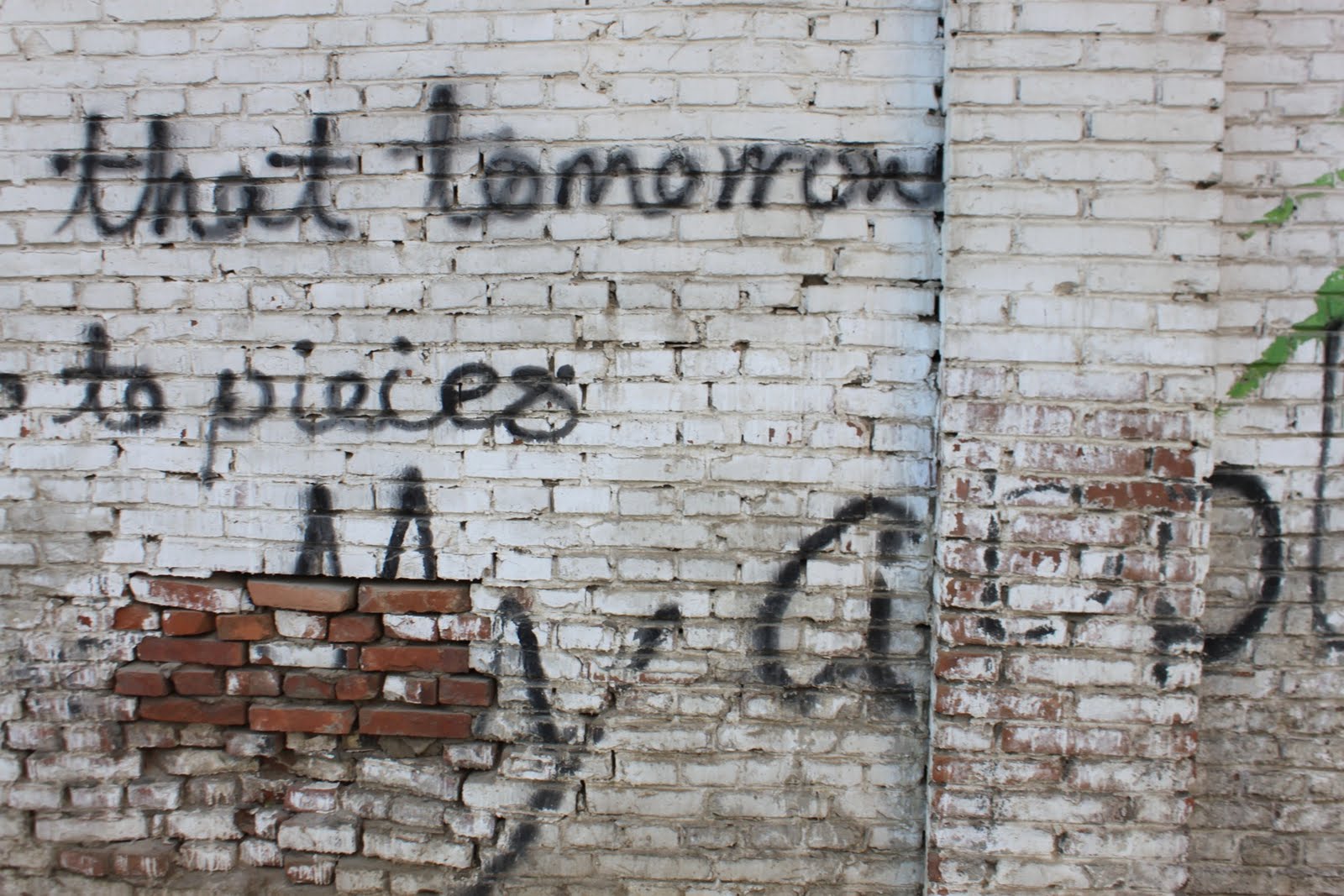
Even if i know that tomorrow the world would go to pieces I would still plant My apple TREE


Also see: still LOVE U.

Sunday, December 18, 2011

Highlights from the latest NYT article on Wukan

Full article here.

The pessimistic:

How long they will last is another matter. As the days pass, the cordons of police officers surrounding the village grow larger. Armored trucks and troop carriers have been reported nearby. On local television, a 24-hour channel denounces the villagers as “a handful of people” dedicated to sabotaging public order, with the names of protesters flashing on a blue screen, warning that they will be prosecuted. Many here fear this will all end badly.

The... not pessimistic:

Here in Wukan, many residents believed that the national government had not yet intervened to resolve matters simply because it had been misled by nefarious local officials to believe that all was well.

So far, however, it seems from inside this locked-down village that government leaders at all levels are flummoxed at their blue-moon, if temporary, loss of control.

Lin Zuluan, 67, a retired businessman who is now the village’s de facto leader, said that officials had approached him to negotiate an end to the protest, but that talks had gone nowhere, in part because the officials would not meet villagers’ demands to return all their land.

“I do have concerns” over the lack of progress, he said. “But I do believe this country is ruled by law, so I do believe the central government will do whatever it has to do to help us.”

Why a big fuck-you kick should be aimed at a whole lot of authorities:

They said that he had died of a heart attack in a hospital and that medical records of his care would be provided.

But family members say officials confiscated their mobile telephones before allowing them into the funeral home, apparently to prevent them from taking photographs. Mr. Xue’s nose was caked with blood, his body was black with bruises and his left thumb was broken, apparently pulled backward to the breaking point, one of them, a nephew named Xue Ruiqiang, said on Friday in an interview.

Saturday, December 17, 2011

We should probably all be following what's happening in Wukan

The New York Times called it an "open rebellion." Business Insider gave three reasons the protests are "totally unprecedented." Roads are blockaded. It has its own Wikipedia page ("Siege of Wukan").

The situation: a bunch of people are angry that government officials or cadres, in cahoots with developers, are evicting them to build luxury housing that they won't be able to afford. Of course they haven't been properly compensated -- oh, and a village representative was killed while in custody. This is a huge deal. Because while chai-qian (demolish-relocate) is common -- the biggest surprise is these large-scale protests don't happen more often -- a death of a well-respected villager is the type of cataclysmic event that can galvanize and embolden the masses, and suddenly a dispute has become a months-long protest.

We should probably be clear about what the villagers are fighting for, though. It's not, as Hong Kong's Alliance in Support of Patriotic Democratic Movement in China chairman Lee Cheuk-yan rather selfishly put it, "democracy in China" (quote: "We are very much encouraged by their struggle and we believe this is the hope for democracy in China.") For fuck's sake, their land is being pillaged; I think "democracy" and all its nebulous meanings is the last thing on their minds. We can help the movement or we can hurt it, and wielding words like "democracy" and, really, "rebellion" (implying overthrow of the government) probably aren't the best. In this sense, this is nothing like Occupy, and not really at all like Arab Spring: these villagers have a specific reason for protesting, and it's a pretty narrow, selfish reason, however justified they are.

Still: we should pay attention. You never know where the threshold is for critical mass, and once that's reached, things will never be the same.

POSTSCRIPT: Somehow related: Christian Bale stopped from visiting Chen Guangcheng. Some days, I tell ya... fuck this government.

Sunday, December 11, 2011

Friday, December 9, 2011

J.R. Smith is the CBA's Carmelo Anthony

Laid out on flu medicine here and just finished watching the Beijing-Zhejiang game on CCTV-5. J.R. Smith missed a three-pointer at the buzzer that would have erased a nine-point deficit in two minutes. Back rim. Decent game.

Afterwards, Beijing's coach basically said Smith had no help and that the team's strategy was to let Smith get his points (at least 37, I think) and contain everyone else. Success!

This might be the Beijing Ducks' year. With its win over Zhejiang (now 5-2), Beijing sits atop the standings as the last undefeated team at 9-0. Every other team has at least two losses.

In another Chinese sports happening, there's this Peak commercial with Shane Battier where he says, "Indomitable heart and aggressive mental power." Perhaps Peak should consider a different writer.

Also, Kevin Love is sponsored by 361. Who knew? It's too bad, because Stephon Marbury's the one rocking that whole "love" theme.

Sunday, November 6, 2011

Last Train Home

Stunning and heartbreaking. So thoroughly stunning and heartbreaking that I don't have any other words to describe the viewing experience. It's perfect in ways many filmmakers wouldn't dare trying to be.

UPDATE, 12/23: Words.

Saturday, November 5, 2011

At the Akon concert last night

It was difficult hearing him say anything over the bass while sitting in the third deck of Wukesong (MasterCard Center, if you insist), but I've never seen so many Chinese people standing at a concert before -- and ushers letting them do it. Akon had the crowd hot, which is a tribute to his showmanship, I suppose, but a real sign of what Chinese club music is all about: American club music that's upbeat and safe, about beautiful girls, basically.

Hope fun was had all around. Here's a clip:

Thursday, November 3, 2011

A note to Chinese web designers

Just now I tried ordering from Pizza Hut's website. There's so much flash and miscellany on that site that it took about 90 seconds to respond to my clicks. I had to click through three fucking pages to get to the fucking pizza menu (never made it). I couldn't apple+click to open pages in new tabs. I didn't find the delivery number.

I ended up ordering from Pizza Company. (4008-113-113 for delivery; one medium pizza for 39 yuan, two for 69 yuan; it's a great deal!)

Tuesday, November 1, 2011

This is so refreshing

From Shanghaiist: Shenhua coach invades pitch to lift injury-faking

Excerpting:

Shanghai Shenhua's coach was so enraged by the play-acting of his own midfielder that he stormed angrily onto the pitch and dragged the offending injury-faker to his feet.

...

The reactions of those around Besek are priceless. Liu himself looks shocked and confused, whilst Shenhua midfielder Cao Yunding appears to be asking Besek what the hell he is doing. Meanwhile, the referee's reaction is priceless, smiling cheesily at Besek and giving him the thumbs up.

Afterwards, and in a video reel, Bezek told reporters that Liu was a professional footballer and that there are some things professional footballers should never do. He said Liu was a young player who still had a lot to learn.

Chinese soccer needs more athletes, fewer cunts.

Actually, this also applies for Spanish, Portuguese, Italian, South American, and probably French soccer, too. (Help me out, what countries am I forgetting?)

Friday, October 28, 2011

There's a baseball game on right now

It's going to the 11th inning. You should probably watch.

Monday, October 24, 2011

Back in the Beijinger

The magazine that held its 10-year-anniversary party recently published this on its blog. Disclaimer: it's got my picture in it. Blagh.

Wednesday, October 19, 2011

NYT journalist in DPRK

If Edward Wang got that crappy hat for three US dollars, he got ripped off. Same hat at Yashow in Beijing sells for $1.50. Less if you can bargain well.

Thursday, October 13, 2011

Cartoon about American politics

I've been a bit harsh on China Daily as of late, but Luo Jie does something good here:


Monday's cartoon

If nothing else, because there sure is a lot of bickering in the U.S., for the sake of bickering, I guess. Can't wait for that election season, huh.

Wednesday, October 12, 2011

Andre Vltchek or China Daily (again) misses the point

Got this from a China Daily article, so proceed with caution, but...

[Andre] Vltchek, who is also a novelist and political analyst, has been discovering places that are rarely covered by the mainstream Western media, and exposing disparities in today's world.

One of his articles, titled The West Perfecting its Techniques to Hurt China, was recently translated and published in People's Daily, a major Chinese newspaper.

"The West has absolutely no interest in human rights in China or anywhere else. How could it, considering that it is violating them on basically all continents, worldwide?" he wrote in the commentary posted a year ago on Znet, a website focusing on politics from a left-wing perspective.


I've said this in various ways on this blog before, but I'll say it again, this time in numbered points:

1. Whether "the West" (western governments) has violated human rights is immaterial to pretty much anything. It simply DOES NOT MATTER. If you're a tenant in rural China who gets relocated because some cadre wants to build a hotel (or if you're a tenant in the heart of Beijing...), whether or not America waterboarded prisoners has absolutely no relevance whatsoever.

Similarly, whether western governments care or don't care about China's human rights doesn't matter either. See above. The idealist thinks that perhaps a country like the U.S. could push China to [fill-in-the-blank], but that's about as likely as China convincing Obama to close Gitmo. In other words, if change happens, it won't be because of a foreign diplomat.

2. There are a lot of people in a lot of places who take governments to task for abuses of human rights. Why don't we talk about the efforts of these civilians instead of dancing around government press releases and diplomatic talk? Does anyone actually find government officials interesting? Their job is to maintain holding patterns, and if we expect anything else from them, we're really giving them too much credit. A more interesting and telling question is, proportionally, are there more or fewer human rights lobbyists in China than there are in, say, the U.S.? Granted, it's not that interesting a question, and we can go a lot deeper, but at least it's not the classic red herring that Chinese commentators seem so fond of: "Because the West is flawed, we're allowed to be flawed as well."

(By the way, I think this is why I took so much issue with China Daily's Chen Weihua in my previous post, who seems to think that the blanket argument "West is flawed" is JUSTIFICATION for China's misgivings (in this case, censorship of media). It's so juvenile: Mommy, but Jimmy's doing it too! To say nothing of the fact that Chen was wrong in his premise -- his premise, I think, being that the West doesn't care about the West's own problems; Westerners do care -- quite a lot, actually. And sometimes an individual who happens to live "over there" turns his or her eye to China, and all of a sudden the natives -- such as Weihua -- flip their shit.)

3. People's fixation -- by "people" I don't specifically mean Vltchek here, even though he wrote about it -- with what "the West" or, more generally, "non-Chinese people" think about China is stupid. It's, again, immaterial to anything. It leads to straw man arguments and non sequiturs and various other logical fallacies that we can generally label "stupid."

But, then again -- and you know this already -- it's part of the country's long process of maturation. China can build skyscrapers and luxury malls and turn a fishing village into a 10-million-strong metroplex within a couple of decades, but changing attitudes and mindsets, well -- no shortcut there.

Friday, October 7, 2011

China Daily insults collective intelligence of readership, itself, EVERY FUCKING PERSON

I'm quite late with this, but I just noticed this column from Chen Weihua titled, "US media blackout of protest is shameful," and I couldn't resist channeling some rancid anger. Excerpt:

While there are many videos of harsh police action on the Internet, I have witnessed how the formerly helpful police patrolling the streets have suddenly resorted to force in Zuccotti Park, also known as Liberty Plaza, in Lower Manhattan.

In one scene, several policemen jumped on one skinny man who was not acting violently. They pushed him down and handcuffed him. Just five minutes later, a policeman waved his fist at a man. That day, seven people were arrested, with one suffering a serious leg injury.


Wow. Pushing him down, handcuffing... sounds like some serious violations of human rights there.

Here's the thing: I understand China Daily's agenda. I know it secretly relishes the role of devil's advocate. I know there's nothing it loves more than using shoddy Western reporting tactics against the West. But what I absolutely don't know yet want to find out is whether their "columnists" (very poorly disguised government shills and general hacks) have any morsel of self-respect. The above-linked column isn't just pot calling the kettle black, it's Chappelle Show "black white supremacist"-level outrageousness. It's beyond "stupid," it's a sort of universal dark matter that is threatening to suck intelligence off the face of the knowable cosmos. A Chinese newspaper -- China Fucking Daily, which is FUCKING CENSORED BY THE FUCKING HIGHEST ORGAN OF STATE PROPAFUCKINGANDA -- calling out any country's media for not reporting on something, when at first there was nothing to report and later there was all this, all this, all this -- Jesus, just fucking google it, asshole -- not to mention this Krugman column, has to be the boldest, most bald-faced expression of "I'm China, and I just don't give a fuck" that anyone can slap down, short of:

China: "Traffic pretty bad, eh Los Angeles? SUCK ON A HERPES SORE, LOS ANGELES!"
Los Angeles: "Um, but Beijing has the worst traffic in the world..."
China: "I'm China, and I just don't give a fuck."

Well done, China Daily. Your quest for legitimacy, especially in those new offices in New York, is going swimmingly.

UPDATE: Article about this in Want China Times.

Sunday, October 2, 2011

Beijing, please

The city has emptied its bowels of people, and suddenly the streets are cleaner, the skies bluer (mountain visible!), the traffic wardens friendlier. (A short old man engaged me in a one-way conversation at a crossing yesterday, details of which aren't important, but it made me appreciate, all over again, the wardens' stupid, stupid jobs.) We are in Golden Week, the country's monthlong celebration of itself, a time when those in the middle class pack their bags and take a leave. The result is a metropolis mercifully relieved of the pressures and stresses of the hoi polloi, the ruckus and racket of the multitude among ones. There are suddenly seats in the subway and bus (and at certain McDonald's). There is a much-needed calm, a great slowing down, leading to a sense that this way of life is the norm. Of course the illusion will be lifted in due time, as this reprieve is as temporary as the blue skies. They will all return, by choice, because to live in Beijing is a privilege and at this heart of the world we are all part and parcel of the rat-a-tat of scuttling feet and all that happens, all that traffic, all that drunkenness, all that fire and ardor, the conflagration and consolidation of hopes and goals. Our choice is clear: Beijing, please -- another. And one for my friend here.

Thursday, September 29, 2011

Just want to get this on the record real quick: baseball

The craziest final day in Major League Baseball history saw the culmination of two epic collapses. The Braves lost after blowing a lead in the final frame. The Rays came back from a 7-0 deficit -- with a solo home run by Dan Johnson in the bottom of the 9th (two outs, two strikes, of course) to tie it -- and the Red Sox, with their presiding closer on the mound, give up two two-out runs in Baltimore mere minutes before Evan Longoria's walk-off home run in Tampa Bay. In real time, moments in the form of movements are fleeting, the world itself transitory; only in memory does time metamorphose into a spectrum and achieve shape, which can be inspected. Focus on one part and you will never believe against the trajectory, never imagine alternatives or that which is not prewritten. Thus we are taught: the slopes of mathematics are fastened to the verities of probability, order. And then it all comes undone. And then -- fans of the Red Sox, say -- are forced to focus on a parallel order, which is chaos. It is tempting -- is it not? -- to see time, that spectrum, as an accordion, and compress it so that we return to the previous spot on our mapped course where the score is 3-2, 7-0, and shall remain that way forevermore, until Boston meets Philadelphia in the World Series, until confetti fall and the world ends, until the end of time.

Now back to your regularly scheduled China news.

What happens when you hold a baseball tournament and no one writes about it?

Apparently the Guilin Tourism College beat Xinjiang University in the finals of the China National College Baseball Tournament last month. I would link to the results or something, except I can't find any, in either English or Chinese. I've reached out to Xinjiang's coach, though, so maybe more info TK in the upcoming days.

This would be the same Xinjiang team, by the way, that momentarily captured the blogosphere's heart last year as it tried to muster the necessary funds to compete in the National College Baseball Tournament in Shanghai. They ended up sending 13 players over.

Meanwhile, the Red Sox and Rays are tied for the AL Wild Card going into the final day of the season, and the Braves and Cardinals are tied for the NL Wild Card. Yes, I will be getting up early tomorrow to watch those games on MLB.tv.

Monday, September 26, 2011

Arriving in Beijing

The train from Dalian hadn't yet reached Beijing East Station on its way to the main station on the corner of Second Ring Road when a recorded message over the intercom listed our destination city's distinctive features, such as the Forbidden City, along with superlatives, such as the "biggest public square in the world, Tiananmen." A neighborhood of shanties swung into and out of sight like the motion of a pendulum, time itself; soon those low-rise shacks will be swept aside by the brooms of construction, their dust absorbed by the free-floating elements above, the haze, through which, at that very moment, a piercing gleam in the distance announced the presence of a golden skyscraper burgeoning out of the earth. A small child nearby kept repeating in a manner of singsong, "Arriving in Beijing! Arriving in Beijing!" until his mother told him to quit it. Arriving in Beijing, indeed. Back home.

Monday, September 12, 2011

Ultimate Frisbee in North Korea

This was the purpose of my trip to Pyongyang two weeks ago. Wrote an article as well, which I'll link to when it comes out.


Related: North Korean kids playing soccer:

Friday, September 9, 2011

Goodbye, fiona...

I never knew you. Except now I find out you also have a Xanga account?! Where have you been all these four years?

Sadly, quirkyBeijing moves down on my blogroll, partly to make room for the excellent Seeing Red in China.

This post was backdated on 9/29.

Monday, September 5, 2011

A trip to Pyongyang, August 27-30

I know I've made a habit of saying, after returning from a trip, that I'll write "more about this later," but this time I mean it: I really will write more about North Korea in the coming weeks.

For now, though, feast your eyes on this video I made:

Full videos (two parts) here:

Tuesday, August 23, 2011

Duke treats Chinese "Olympic Team" like Fairleigh Dickinson"

It was not, of course, the Olympic Team we all know, because last I checked, the Olympic Team was coached by Bob Donewald and has Yi Jianlian. That team would have crushed Duke. The one that played last night went down 28-6 and, despite spurts of competence, never really challenged the Dukies.

In case you were wondering: Duke: 3, teams from China: 0.

The highlight of the night -- other than a couple of monstrous dunks by the Blue Devils -- was a mascot copping a feel from two Duke cheerleaders, and the Blue Devil mascot going up to that other mascot and doing a "get the fuck off your knees you pervert" hand motion. I really, really wish I'd gotten video of that.

I'll have pictures and a vid of something else in a couple weeks or something.

Monday, August 22, 2011

This is Duke

"The veteran-laden white squad dominated in full court action in a steamy MasterCard Center."
--From Duke's athletics website. A Day in the Life.

I'll be at the game tonight, so if anyone has any good Duke-related heckles, let me know ...