Saturday, June 27, I met my cousin Zhang Peng and Alicia at Haidilao Hotpot (Huoguo) (海底捞火锅), a fairly famous restaurant on the top floor of one of Xidan's mega-malls. Eight days later, which would be this past Sunday, July 5, I met my other cousin, Mingyu, and my uncle (haven't written about Jiujiu for a while), who was with his wife and twin sons (Fang Fang and Fei Fei), at a place next to Haidilao called Jindacai Shaokao (金達萊燒烤 (traditional characters)), an all-you-can-eat Korean barbecue. You basically stack your tray with uncooked meat (they have cooked foods, too, like chicken kabobs, salads, jello, cake, dumplings and cold noodles) and take it back to your table to grill, and every 10 to 15 minutes or so a waitress comes around to replace your grate with a fresh one. Meats available beef, pork -- indeed, bacon -- tripe, kidneys, king shrimp, chicken breast, chicken leg... and more! -- all for RMB 58.
Please compare...
Haidilao: They have a cornucopia of dipping sauces.
Jindacai: The beer is all-you-can-drink, too.
An added bonus at the Haidilao place comes when you order the noodles. A man will actually appear with a clump of dough and pull the noodles into shape right in front of you, like so:
I think my verdict would be the barbecue joint, if only because I'm a sucker for buffets. You really can't go wrong with either though, if you're ever in the area.
I attended Olympic boxing Saturday night with Jiujiu and wrote a story for ESPN The Blog that was published today. I've reproduced excerpts of an unedited version below.
Let's just say the bouts didn't get good until the Chinese took on the French, in the fourth bout of our evening. Then hell broke loose in the arena.
"The Sweet Science." It could mean many things yet nothing at all, and so it is that boxing is likewise hard to pinpoint. Is it a science for its technicality or art for the humanistic exhilaration of mano a mano battle? Is it sport or brutality? Is it competition or assault? Throw the phrase "boxing is called the sweet science because" into Google and you won't come any closer to an answer ("Boxing is called the sweet science because thats what it really is when you watch the best fight" [sic]). The best you can hope for is to take a seat and soak it in.
That's why we were at Workers' Gymnasium Saturday night, taking in eight pre-quarters bouts in the light fly (48 kg) division. Amateur boxing may be under fire for its scoring system, which awards points for punches deemed successful ("They way it is now, you might as well do fencing if they are going to judge like that," Britain's Billy Joe Saunders said after he lost his welterweight fight last Thursday), but that doesn't detract from the excitement of being in the venue. One bout in particular comes to mind.
...
Yanez was gracious in defeat, congratulating his opponent and going over to shake hands with the Mongolian trainers. He exited with dignity, even as an unpopular decision -- yet another in a string of many -- left fans shaking their heads. Science? Hardly. If but only for the saving grace of sweetness.
Anxiety is rippling through China. Millions of people know that what happens over the next two days could be a crucial turning point in their lives.
Think I’m kidding? Then you don’t understand the pressure that builds every year at this time before the annual college entrance examinations across China.
It’s a pressure cooker out there.
He's not kidding. Mingyu, who you may remember for his extraordinary musical talent, recently finished his gaokao (college exams), and now the waiting begins.
Mingyu may be able to hit a high C, but he has deficiencies when it comes to book learning. He's taken these college exams once already in hopes of entering a highly respected national music school -- and failed. This time around, he needs to score 285 to qualify for the Beijing Music School, a mark that isn't considered very high. I mean, it's not like he's going for Tsinghua University, or some other school in the top 30. But as to whether he'll make it...
Jiujiu said to me at lunch today, "I asked him how many of those ancient poems he's memorized, and he replied, 'None so far.' So at that point I thought" -- and give Jiujiu credit, he said this with a laugh -- "it's gonna be a close call."
All Mingyu needed was to average about 60 percent, and it looks like he might not get there. Yikes. The results won't be in for a while, but for now I can only feel a little stress with (for?) him. I remember my SAT-prep days, and they weren't very fun.
Jiujiu, the finance manager in the five-star Jade Palace Hotel, used the phrase "pai ma pi" (拍马屁 -- I think) today, which basically means to "suck up."
"With you here, they'll get a chance to pai ma pi to me," Jiujiu said in the car. "I haven't really given them that opportunity yet."
When I asked what that meant, he gave me another phrase, and when I asked what that meant, he rattled off something new, eventually telling me to ask my mom.
The rooms here -- 410 in all -- go for a range of 700 RMB per night to 1,288, if you reserve early. During the Olympics Jiujiu expects that price to go up to 2,688-3,288 RMB. Of course, this doesn't include the 16-room Presidential Suite, which right now goes for about 38,000 RMB (about $5,500).
The above is an example of the sort of writing no one cares about -- I imagine the pictures are more interesting. When I started this blog three weeks ago I had that style in mind: personal, small and insignificant. Along the way, however, I've come to realize how irresponsible it is to broadcast the minutia of everyday life, especially in the face of a world that totters about under the weight of colossal issues such as natural disasters and global warming, seeming like a toddler needing guidance and direction from people like us, journalists, scholars, writers and the like. A personal blog is a dereliction of duty, especially from a journalist. It borders on narcissistic, even though I have no vested interest in my own life outside of living it.
But it is easier, keeping this in journal-form. And I did make a declaration way back when... maybe that'll be my excuse until further notice. Maybe I switch styles after my family's all been introduced, in June or so. There's time yet.
For the moment, you'll have to settle for this commixing of the pedestrian with the grave, a style that'll win me even fewer followers, I believe, but so be it.
A little dated, but this NY Times column from Thomas Friedman is spot on and worth sharing. Excerpt:
Our president’s latest energy initiative was to go to Saudi Arabia and beg King Abdullah to give us a little relief on gasoline prices. I guess there was some justice in that. When you, the president, after 9/11, tell the country to go shopping instead of buckling down to break our addiction to oil, it ends with you, the president, shopping the world for discount gasoline.
We are not as powerful as we used to be because over the past three decades, the Asian values of our parents’ generation — work hard, study, save, invest, live within your means — have given way to subprime values: “You can have the American dream — a house — with no money down and no payments for two years.”
Hopefully you caught the phrase "Asian values." I think that's a fitting usage there.
It just doesn't stop. Here're the last three paragraphs of a CNN story about a middle school in Juyuan, where nearly 900 kids are trapped:
While boasting only basic facilities -- a concrete courtyard, netless basketball hoops and soccer net made of steel pipe -- Juyuan was a magnet school attracting the region's top students, many of them from isolated communities who boarded in an adjacent dormitory.
Unless more survivors are found, the quake will have wiped out the school's entire graduating class and about half its student population.
"They were all our friends, and we'll miss them a lot," said a Juyuan seventh-grader who gave her name as Xiao Mei and wore the school's red, white and blue track suit uniform. "I'm very sad."
There are no words for this. I'm trying to come up with some, but I don't think they're necessary. Don't think for a second this is over, either. The death toll will increase, and probably drastically over the coming days.
The Black and White Cat has some haunting pictures up on its site, and right now I'd recommend to anyone interested in following this story to make daily visits to Shanghaiist and Danwei. My aunt emailed me not too long ago and said she was thinking about contributing a few Yuan to the relief effort. A few Yuan, of course, is nothing, but... it's something. The Shanghaiist and Danwei both have donation info, as does Time's China Blog. And NPR's got a Chengdu blog that's worth checking out.
SPEAKING OF MY AUNT, I got some information last night from Jiujiu about her arrest in 1976 (I alluded to this in an entry yesterday). It was the summer after Zhou Enlai's death, and the people wanted to mourn his passing. But Mao Zedong's fourth (and final) wife, Jiang Qing, wouldn't let them, and chaos ensued. My aunt, 16 years old at the time, was riding on a bus with a friend* when she noticed a building on fire. She and her friend hopped off and ran inside, wrapping phones and other electronics in blankets and throwing them onto the lawn below. Don't ask me why she was trying to save phones -- I asked Jiujiu this and he replied, "Well, she was just 16."
*This was a close friend, also 16, and male, and I surmised this was the friend with whom she had, a few years later -- I don't think I'm making this up -- a torrid affair which resulted in unspeakable heartbreak from which she hasn't fully recovered. Again, I don't think I'm overstating things, but the full story I don't yet have.
As it so happens, the building was a barracks -- it's gone now, but it was located about half a kilometer from where the history museum now stands -- and the fire had been started from a carbon monoxide bomb of some sort. When my aunt and her friend emerged from the burning building, they were set upon by a group of soldiers, residents of the barracks, who had been watching them. My aunt's hands were bound and eyes blindfolded, and that's what happens when one gets arrested in China.
There was no trial, nothing. My laoye's status as a veteran and party loyalist could not save my aunt -- this was, you will remember, during the Cultural Revolution. My uncle, who was in the same grade in school as my aunt (11th) despite being two years older, would soon be sent to a factory for his "reeducation," and my mom, two years older than Jiujiu and out of high school, had already been booted to the countryside. My aunt began her prison sentence on April 5 and got out on July 27.
On the day she was released, my mom picked her up and the two of them talked nonstop until two in the morning. (There was solitary confinement, that's all I know.) Shortly after falling asleep, the ground began to tremble. The walls swayed. Books fell and furniture shifted. This was the Tangshan earthquake, eventually known as the Great Tangshan earthquake, a 7.8-magnitude expression of rage and brute force that would become one of the deadliest disasters of the 20th century, claiming more than 240,000 lives. Until a few days ago, Tangshan was just another place. Now, every report that says the Sichuan earthquake was the "worst in more than 30 years" is making a direct reference to Tangshan, and we're left to wonder about history's cycles and whether the good doesn't repeat alongside the bad.
I'm not sure how to end this story except to say that Tangshan is close to Beijing -- much, much closer than Sichuan -- and that that night in 1976 sort of occupies a significant though unspoken place in my family history, as it does in many Chinese families' histories. For slightly different reasons, obviously. I wonder how best to bring this up to my aunt in the coming days to ensure a reply.
UPDATE: By far the most comprehensive entry about giving aid for disaster relief, via CN Reviews.
By far the most comprehensive blog entries on the Sichuan earthquake came from Shanghaiist (100+ updates) and The Beijinger (TPJ), but Danwei also has a nice entry from its archives on the Tangshan earthquake of 1976, which my family has spoken of (the aftershocks rocked Beijing on the night my aunt was to be released from jail... she hasn't said much on this subject -- a protest was involved, and a house fire, I believe -- but the experience left a lasting impression, this I know). Over at Global Voices Online you can watch several videos and read reactions (translated) from people at the scene.
Yesterday I expressed my admiration for Renaissance man Hu Jintao and his many skills, but I should have linked to this article from TBJ: Hu Jintao apparently likes baseball. He hasn't played in 50 years, he says in the video (which is hilarious), but he professes a long-held fondness for the sport. The proprietor of the Kansas City Royals blog In Dayton We Trust salutes him.
Remember when I said I think Chinese women are less conservative than people suspect? Here's a little of what I mean: the ad to the right was found on ZDface.com, a glamor website that advertises the sexiness of high-heeled shoes and the like. The product, in case you haven't noticed, advertises "More chubbiness chest." It's a lotion called Ardme (I think). Feel free to explore their website.
Jiujiu is home, safe and sound. And life resumes as before.
Sometimes -- it's rare this happens, and when it does it's usually self-incurred, me spending too much time in a room by myself -- I get a sinking feeling the world's gone mad and I'm the last witness. I opened a browser just now and look what popped up:
In case you're keeping score at home, that's:
Storms kill 22 over Mother's Day weekend ... gas prices hit 5th straight record ... bloated bodies rot along Myanmar river ... 3 men die in 'detergent suicide' pact ... wildfires rage, stamp prices increase, death and love, another suicide and, oh yes, a horrific earthquake. The entire gamut of human tragedy, menial to profound, edited to fit into one website sidebar.
Then I refreshed my browser and this came up:
3,000.
Add that to the spiraling death toll in Myanmar -- if you've followed the story at all, you have to understand how surreal it seems, when at first our reaction was, "Oh, cute, a cyclone," and progressed to, "What, 350 dead?" to "What, 4,000 dead?" to "What, 15,000 dead?" to "What, more?" Radio Netherlands Worldwide dropped this bombshell recently: 80,000 are feared dead from a single district. I'm usually a stickler for grammar, but I think it'd be okay if I ignored conventions for a bit: !!!!!!! !!!! !!!!!! -- and the tornadoes that hit the Midwestern United States and the nearly 300,000 that died in Asia from the tsunami in late 2004 and Katrina in 2005 and you just have to wonder...
What is it Joseph Stalin said, One death is a tragedy, a million is a statistic? What a brilliant quote, seething with the cold, malicious cackle of irony. There is nothing statistical about this:
My uncle (Jiujiu) called me while I was sitting down to dinner today and asked if I felt any tremors. I told him I did not. He said, rather matter-of-factly, that an earthquake had hit Sichuan, and that the aftershocks should be rolling around sometime soon, and for me not to be worried. I told him OK.
I had no idea 3,000 are dead.
I know this is natural, just nature's way of shaking its coat of fur of bits and pieces that have bogged down its circadian rhythms. When we overpopulate, there will be repercussions: taketh what he giveth, that sort of deal. Still. There can be something powerful yet about statistics, something evocative of absence, which cannot be known except through juxtaposition with presence. Something warm has been blasted into oblivion and here I am, by myself in a room quiet as a summer breeze, wondering how we get it back, if such is possible or desirable.
Let's pause a moment. Links from this past week follow.
More on the Sichuan earthquake, from Times Online.
Elaborating on two stories from CNN's sidebar, above: Time reports that the D.C. Madam preferred suicide to prison, and the Economist, a couple weeks ago, wrote about Japan's new suicide craze, toilet bowl cleaner with bath salts (or "detergent and other chemicals," as CNN puts it). "Death be not proud" was the article's title. Amateur scholars who modernize the poem "Death be not proud" inject it with exclamation marks, as if the narrator were some young, lovestricken soul raging against this dark, nebulous force for which our only defense is recalcitrance; in reality, John Donne's voice was one of rueful acceptance, of receiving death not as an adversary but a friend, imagining him as some gatekeeper allowing him to pass into an otherworld where death, poor death, is never heard from again. In other words, the Economist did Donne no credit, but I give them props for shedding light on an important issue.
Of prostitution I have only this to say: what's so wrong with it? I've read both sides of the argument -- more swayed by one side than another -- but I'm interested to hear what you have to say.
More on Hu Jintao's visit to Japan: does anyone else find it pleasantly odd that a world leader can be so well-balanced? We know President Bush can throw a baseball (unless he's being booed by 2/3rds of the stadium in his adopted town of D.C. on Opening Day), but Hu Jintao can probably do that while hitting high Cs in a falsetto. In Japan he wrote calligraphy, taught Li Bai and, in case you missed it, slammed home a series of points in ping pong (my shushu, somewhat of an expert ping pong player himself, commented that it takes skill to successfully spike four times consecutively, which President Hu apparently did). According to Japan Today, "[Japanese Prime Minister Yasuo] Fukuda later in the day told reporters that he 'chickened out in the face of good players.'"
"Bear-baiting," via The Opposite End of China (newly added to blogroll). Exerpt from The Age (Australian newspaper), quoted within: "Today, the West is involved in a game of bear-baiting with China. China has been awarded the right to host the Olympic Games, about which it has worked itself into feverish excitement and so, correspondingly, the West is in the process of humiliating China, with the Tibet issue being the West's most effective stick. It is daring China to respond, knowing that China won't because it does not want to risk a boycott of the Games. China is like a tethered bear."
An English Teacher in China, just discovered today, is quite a nice resource for those interested in teaching English in China (there's a light bulb warming up in my head). In today's post, the author wrote, "Her friend, the married one, thought that while Americans may date a lot before and are more 'open' than Chinese before they get married, but after they get married they become quite conservative maybe more so than Chinese are." I concur. I've heard the same thing -- Jiuma and her friend, Zhang Ting, said this a couple weeks ago -- that Chinese husbands are much less loyal to their wives than Western husbands. It makes sense, I suppose. Then again, it's my theory that unmarried Chinese women are a lot less conservative than people suspect. This theory will have to be tested.
Via China View: "Beijing, with 5,174 public toilets, has outpaced New York, London and Tokyo and become the world's No. 1 metropolis as far as public toilets are concerned." I wonder if they're counting squat toilets, because those most definitely should not count.
POSTSCRIPT: Please notice the tags on this post. This blog better get red-flagged after this.
UPDATE, 12:07 a.m.: 8,500 dead and counting. Jiujiu's in that part of the world right now -- not that far southeast, I don't think, and he did call during dinnertime, so I think he should be just fine. He was supposed to take an overnight train back to Beijing three and a half hours ago, but with aftershocks registering 5.0 on the Richter Scale around the countryside -- felt even in Pakistan -- I don't think he's going anywhere. Tried calling but his cell phone's off -- CNN's reporting communication lines have been cut off everywhere. Will update tomorrow.
We've had four of these dinner conversations, which I'm beginning to cherish. The first was about Tibet. The second, Moutai. Most recently, over Moutai, we talked about Jiujiu's trip in 1994 to the American West, when he was still a relatively young man of 36. He stopped in Washington (state), Oregon, Las Vegas, Hollywood (where his office companions left him hanging in a museum, which he perused by himself, listening to performers, then studied a bus schedule for a long time (without much luck), found a Taiwanese student who was also lost who advised him to get on the bus and go one stop down, eventually leading to a reunion with the office workers who complained, "We looked and waited for you!" to which my uncle, with a laugh, told them, "You didn't look that hard... I watched you get on the bus and leave!") and San Francisco, where he tried, unsuccessfully, to dial my mom using Collect ("There's a way of dialing where it charges the person who picks up the phone, not the dialer..." "You mean Collect?" "Yes, that's it. I used that."). He did this just before boarding the plane, and when it didn't work, he asked an airport employee to try it for him. The airport employee looked hurried, but he tried, and when he couldn't get through either... "He worked up a head of sweat!" Jiujiu said with a laugh.
What follows was our third conversation, reproduced to the best of my ability.
This past Saturday I was getting ready to head out to the Goose and Duck Pub when I apparently drew the concern of my jiujiu, a wise, level-headed guy who's not very unlike myself. It was getting late, and he suggested I wait until the next day to go. I told him I couldn't, that I'd already gone in the morning (to watch the Houston Rockets lose amid Chinese fans, only there were no Chinese fans because it had been pouring rain and the game wasn't on TV... just a laptop), and that I was supposed to get introduced to the bar's boss, an Irish-Canadian named John. They were expecting me, in other words. (And they were -- I got a couple business cards and a story pitch out of it.) Jiujiu, knowing I wouldn't stay in, decided to give me a talk, instead.
GHB. Cocaine. Heroin. Other stuff. There's a drug called "shake-head drug." Makes your head swivel. There are other drugs that don't have names. This is China, was the gist of what he was saying. You have to watch out.
A string, he said -- after imitating a violin player, then asking me what instrument I used to play (it was the violin; I should note here that Jiujiu knows a few words of English, but sometimes the words he uses are literal translations; string, in this situation, of course makes no sense; he means "seed"). I need to plant a string in your head, to know this exists.
At dinnertime the topic surfaced again, though completely unexpectedly.
Have you seen the movie -- the documentary -- Hong Kong Box? he asked.
I had not.
They talk about a black box. You know what a black box is?
A box that's black?
It's black, so you can't see inside. Like, what does it mean to say we're black boxes? You can't see my heart's secrets, I can't see yours. To the West, China is a black box.
I nodded.
He got on to explaining how this documentary depicts various Western nations, and that the French come out alright. The Germans, on the other hand -- they're doctrinaires.
In what areas are the Chinese smart in? Jiujiu asked rhetorically (at least I assumed it was rhetorically). If you're buying eggs, and one egg costs one dollar, then if you want to buy 10 eggs, they'll give you 10 for 10 dollars.
The Germans, on the other hand, will give you one dollar for one egg, then another dollar for another egg, and so on until they've reached 10.
This is a very simple example, Jiujiu continued, but you can extrapolate from that.
The Chinese who do good do good better than perhaps anyone else in the world. But those who do bad do that better than anyone else, too.
In 1949, when China wasn't recognized by the West, they were friends only with Russia. The first TV came from Russia. Eventually they learned AC circuitry, and within years everything had AC in it. (I think he was after the term "alternating current"; not positive though.)
He explained -- all very tangentially, of course -- the materials inside the first TV, and bet I hadn't seen one more (I'm sure I have in Science City or the Smithsonian).
In the late-50s, China detonated an H-bomb, my uncle said. Then the atomic bomb. In the 60s, China got a man in space. In other words, the speed of the country's progress was incredibly fast. The Chinese are very capable people.
But my point is, Jiujiu said, and it was good he said it because I was beginning to doubt whether there was one, there are those who are equally adept at being cruel. It takes study and practice to do good, but some people don't have access to learning and books. So they apply themselves in other areas.
Law in China is very loose. It's a relatively new idea, probably only 40 years old, because not long ago there were emperors, who were like the country's parents. Whatever they said went. The idea of law is unfamiliar to some people. They don't know law exists. They think they can do whatever they want. And the enforcement is sometimes just not there.
You see people who are good and caring -- you're around them -- but there's another side, too. The underworld.
Then he told a story of one of his bureau's employees going to Yue Lan. I was supposed to go, he said, but didn't. I let this colleague go instead. He was seven or eight years younger. They were having a meeting there with three or four other people, and afterwards a car picked them up to take them out partying. He took a smoke from someone, and then he disappeared. Later, when everyone had left Yue Lan, he still hadn't been found. The office sent people back to find him. Eventually he surfaced, but he had no idea what happened. And his head was never the same.
Where is he now? I asked.
Don't know. We considered him a sick man after that incident.
You have to always be skeptical, Jiujiu said, soberly. Even after you meet someone for a second time, and third. At a sports bar everyone's interest might be focused on the games, which gives you the impression that things are safe. Someone may want to take your number, but it's best not to give it out. Then again, you could become friends. That is a possibility. But you have to have this "string" in your head.
Good food should always be enjoyed with good company and Moutai, which is 106-proof baijiu (white wine). I had five shots last night -- though you're supposed to sip Moutai, thus is the fullness of its flavor and spice.
China is a fantastic place for food, despite the fact that, according to the Time China Blog, not one Chinese restaurant was named in the "World's 50 Best Restaurants" list, according to some London website. Western media bias!
I've been eating so much since getting here that, up until two days ago, I was sure I'd gain 10 pounds by month's end. It's just that two days ago, on the bus, I noticed that my wrists were thin as always, and I began to wonder if there's nothing I could do to put on pounds. Oh well. I'm sure I'll wish for these days when I'm fat and slovenly in 20 years.
From the first night in town.
At Hebei after furniture-shopping, eating their famous meat pancakes (that's a radish on my pancake). The meats we got: pork, donkey and a sort of bird I didn't recognize.
A couple of Zhang Peng's friends: Xing (left) and Kang Li.
One of my favorite dishes of all time, which I can make, too.
Nainai's cooking.
Xiao Wang (Jiujiu's current wife) stirs the green beans.
At the restaurant with Jiuma and Mingyu two days ago.
Jiujiu frying fish last night. He's a very, very good cook.
The concoction on the left is a special kind of noodles dish you can't get in Beijing -- Xiao Wang brought it over from her family's farm -- made with yellow peas, which smell notoriously stinky before they're cooked but are flavorless afterwards. The noodle is thick and creamy, and should be served with various greens (I don't mean salad -- that's a very Western food). This was very popular with Laolao, and the taste for it has been passed on to Jiujiu, who ate four bowls.
The assortment of food on the right is what I had for dinner last night.
Note: If nothing else, just scroll down and watch the video.
Jiujiu and Jiuma (Zhang Yanggang and Zhen Yi) were married seven years when they decided to split, a decision probably met with applause from members of the Zhang family. To them, Zhen Yi was, to put it nicely, bratty, stubborn and overbearing, an uncompromising woman whose personality was much too big and pompous. It's possible that Laolao -- the matriarch of the Zhang family who never did like her*, not on day one and not the day she passed away -- may have colored others' perceptions, but I prefer to think that the marriage was doomed from the start. The two were too strong-headed -- that's the real basis of the antipathy between Zhen Yi and the Zhangs, the powerful personalities on both sides -- and neither could settle into their roles as spouse and parent.
*I remember Laolao as a key ally in my rivalry with Mingyu when we were little, she always calling him "little fat duck"; "Look, there goes the little fat duck!"
It's true, of course, that Jiuma can be bratty, stubborn and overbearing. One of her foremost skills in life -- which she'll happily announce -- is her ability to haggle. She would, to put it plainly, not give an inch to Scott Boars, and she would win. I got a glimpse of this last week (when the above-picture was taken) at a furniture mart outside of Beijing, an account of which is here. She's the type who demands to have things a certain way, and at her disposal is a personality that can alternately charm and poison. One moment you're being cooed by this sweet, personable lady, and the next she's insisting you do this and that. It can be jarring, to say the least.
But Jiuma also has a deep reservoir of affection that she dips into unreservedly. To me she has been generous beyond words, beyond obligation. She often speaks boastfully of her three years carrying me around when I was little, between the time my parents left for the States and my joining them, and to this day will occasionally call me Son. Yesterday she pulled out this whopper while on a bus to Panjiayuan Market, in front of Mingyu: "Originally I didn't want to have any kids. Then I took care of you and decided it'd be fun after all." When she repeated this at dinner to all the guests, she added, "So, Mingyu, if not for him, I wouldn't have had you." She said this playfully, not intending any other meanings, but I couldn't help but blanch.
Of course, Jiuma has never been discriminatory with words or hesitant about sharing her thoughts. Everything she does is writ large: her stories always toe the line of hyperbole, her promises always delivered with an earnestness that'll have you forking over every hope. She has no acquaintances, only friends -- and few plain friends at that, more of them of the "good friends" variety. For those close to her, her uncompromising impulse to have more and want better can be seen as unsavory; as humans, we may have programmed in us a wariness of the overly ambitious. But she knows no bounds, and I'm not certain how she came to be this way... how her family raised her, what experiences led her to believe the city could come to her fingertips. She counts, among her friends, the first professional Chinese basketball player to play in the U.S. (it's a woman, and I'll give you five bucks if you can name her off hand), an Olympic weightlifter, a big-time movie director/producer and a menagerie of government officials, big and small. She surrounds herself with talented people who would seem better than she, and this includes her personal life; she would never be called "good looking," but Jiujiu certainly would be, and her current boyfriend as well, a Shanghai businessman she has wrapped around her finger. If this were America, I'd say she does it with sex. But this is China, where a forceful personality, sizable Rolodex and willingness to buy lunch/dinner can get you far, and she has all those.
She is the ideal "Connector," a term popularized in Malcolm Gladwell's Blink. In other words, she is a woman of today's China, bridging Old China, which values plain old work habits, with New China, which emphasizes networking. Basically, Jiuma is as valuable to a journalist/writer like me as anyone in Beijing, and I should be grateful she's on my side.
If you've read up to this point, however, you may have deduced from my tone that I'm not 100% sold. I'm suspicious, more than anything, of exactly how much Jiuma actually knows, how much power she actually has relative to power she's claimed. It's a terrible thing to say, but asking too many favors from Jiuma would make our bond seem conditional, thus lesser. I wouldn't want that. And there's also this: there's no one I'd less rather do business with than Jiuma. The way she operates strikes me as a bit underhanded, like when she asked my dad to give her money to pay one of the officials he wanted to meet with ("That's how it's done here," she had told him). Every one of her friends I've met so far have seemed a little manipulative, as Jiuma kind of is. They've all been fiercely opinionated and even dogmatic in their opinions, two-faced and with ulterior motives.
I haven't met all her friends, but the ones I met at dinner last night were definitely this kind. There's no need to introduce them -- I didn't catch half their names, and the ones I did catch I've forgotten -- but I engaged a few of them in conversation on a variety of topics, from Jack Caffrey (they asked) to covert racism in America. I'll touch on a couple of these points.
QUICK INTERLUDE: One of Jiuma's friends came in late because he was getting a foot massage downstairs, which reminded me of the two times I've gotten foot massages in Beijing, most recently on the first night back with Zhang Peng and two of his friends. I have to say, the foot massage feels like it should be sexual, but it's completely not. In fact, the gal who worked on me that first night, when all of us were drunk, had the gall to make fun of my Chinese. "What are you trying to say?" she demanded. To which one of Zhang Peng's friends blurted, "He wants to sleep with you," which was untrue but, now that he'd mentioned it...
(There's this thing they do at the end where rub your thighs, and I don't need to tell you one's thoughts during this process.)
Maybe there's something about foot massage parlors that I don't know yet. A secret gesture, perhaps. I want to find out, if there's anything to be found, because I know for a fact that massage parlors here, like in U.S. Chinatowns, can double as houses of ill repute.
One of the guests -- a Chinese man who has worked nearly 20 years in the U.S. and who I learned lived just a few blocks away from me in New York on 103rd and Riverside -- tried to tell me that because of my face, my opportunities in the States were inherently fewer. He actually used that word: "face." "But because of your face," he said. I immediately told him this didn't matter, as I've never been interested in climbing corporate ladders or gaining social credibility. Then I thought about this, and several minutes later I said, in pleasanter terms, that I thought his idea that Asians were held down because of their appearance -- that "blacks have it easier in the corporate world than Asians" -- was bullshit.
"It's about personality," I said. "It matters more in the States. If you can joke around with the boss, not be so deferential, possess one set of characteristics instead of another, you can get that promotion." I should have used Lou Pai, one of Enron's top executives, as an example. He had a very Chinese face, yet he succeeded (so to speak). (NPR's summary of him: "Lou Pai is the real mystery man in the Enron scandal. A former executive of the energy trading firm, he cashed in an estimated $270 million in stock and left the company before it collapsed, divorced his wife, married an exotic dancer, bought an enormous piece of Colorado, sold it and then disappeared into obscurity.") My New York neighbor seemed dismissive of this idea.
We also touched on the subject of parental treatment of children, and all the adults at the table agreed that my generation doesn't really get it. "You don't know what it's like to suffer," they told me, almost scolding. When the face guy said it's sometimes hard for him to understand his daughter's conversations, I told him it's because Americans like to communicate in ironies. He didn't seem to know what this meant, but instead of asking he just looked blankly at me. "You know, saying one thing but meaning another," I added.
"Oh," he said. "The Chinese do that too."
This was, in effect, how my conversation with these adults went: me saying one thing, them deciding I didn't know what I was talking about and moving on with their own ideas. It's funny, I thought, here we are in a discussion about the problems in the generation gap -- them saying generation gaps are inevitable yet mourning this fact, pity their poor, inflexible ways, woe to the incomprehensible, know-nothing youngsters -- yet here, right here in front of my eyes, was the manifestation the problem. These old bastards.
They related this to China (the subject of the press was also involved, somehow). "There will be a transition period," one of them said.
"Yes," another agreed, shaking his head. "There is no doubt about that."
And all I could think was: if by transition you mean you stepping off the stage, then by all means, transition away.
There was also this: the lady pictured. I've always been impressed with women who have the confidence to wear an empire waist top, and so it is with this woman here, whose facial features and bodily proportions are almost perfect for this style of dress. In addition, she had the good sense to wear a black skin-tight shirt with black leggings, and while you can't see it here, she has the most delicate feet, in these simple, unadorned one-inch platform shoes that look like they might easily slip on and off. She caught my eye from the get-go, then started looking better and better with each glass of Yanjing (it's official: the best cheap beer I've ever had). You want to take a gander at her age? Go ahead, I'll wait.
While I'm waiting, I'd like to say for the record that I am not a proponent of affairs. While I think very little of marriage -- the institution is no more sacred than a handshake, in my opinion -- I feel very strongly about the things that bind us together, individual to individual, and I think it goes beyond saying that those who would knowingly and maliciously try to break these bonds might deservedly be called scum.
Yet there is also that other possibility: marriage where trust is undefined, thus without. What exceptions can be made in those situations, and would they be called exceptions? One more thing, because I do, despite the occasional slip-up, understand these postings are public, and that one can never quite be sure who's reading what, or not reading this, and taking what meaning from what: I'd also like to state for the record that I didn't actually seriously think seriously about making a move on this woman, no matter what sort of things were running through my mind... not that I would've had success, anyway, despite some dark grumbling from within telling me she wanted it. To the police guy who looked kinda tough sitting two seats away from me: if you get a hold of this, please don't kill me, even if the restaurant owner offers you more money than you'll ever make in your lifetime.
Here's a better picture:
I'm guessing on her age, but I'd say 40, since her son is already 13 and her husband, a bald, rather [adjective deleted] man, looked about 55. You would never be able to tell, right?
She was reserved, unassuming and alluring, possessing the sort of amor that comes to those wholly comfortable in their beauty. She knew -- as those who are beautiful know -- that glances come her way as compliments, not out of distaste or indecency but because they can't be helped, those eyes, poor eyes. I wondered once more how her husband came to have her, and what innocence he may have spared. They were shameful thoughts, but they were guarded, I think. Were they? Did she espy a little too much in my lean-to? Did I suggest too much? Or not enough? Did she just lean when she said, "I have a question to ask you"? Could she have known I was secretly sneaking her into pictures? What desires might she have, and would I know them without asking?
I will never have these answers, such is the harbinger of impossible. It would do us well to move on to something wholesome.
As the title of this post states, Mingyu is a very talented young man (not at pool though -- I beat him three out of four... or was it four out of five? But he did beat me two out of three in Chinese chess). He's testing for the Beijing Music College, which is sort of like China's version of Julliard though not quite so good because all the best musicians study abroad. Anyway, Mingyu's goal is to eventually go abroad, to either Italy or -- this is his mom's dream -- Julliard. The following video is of him singing karaoke, without warming up and having gone weeks without singing (on account of his surgery). He would, it is fair to say, win $50 off his tab at any local Karaoke Night competition.
(Apologies for the background voices in the video... if you click on the video, you'll find a video response that's a longer clip of Mingyu singing. I'll get him to perform just for the camera sometime, and then you'll get a better idea of his vocal range.)
Fang Fang and Fei Fei are Jiujiu's (uncle on mom's side) twin sons by his second wife. They're a year old and bundles of joy when not crying and annoying their dad.
In interviews, occasionally I'm asked, "How would you describe yourself?" Next time I will answer: "Let me give you an idea of the things I think about. I was standing in a public restroom in Hebei -- that's "North Lake," just north of Beijing -- looking down at a row of three squat toilets -- no walls separating them, mind you -- two of them just about overfilled with mounds of feces, when I wondered, just before doing my business -- No. 1, not 2... thankfully -- whether I should be regretting that I don't have my camera on hand to snap a picture. You know, to post on the Internet. I would be that sort of employee, too: mindful."
Yao Ming and Jingjing (its real name) welcome you into Beijing.
Here are some pictures I took while my uncle (pictured right) drove down Changan Jie after picking me up at the airport on Wednesday. Changan Jie, or Eternal Peace Avenue, is the main thoroughfare in Beijing, a East-West street on which you'll find a bunch of foreign embassies, Tiananmen, the Forbidden Palace, Beihai Park and more foreigners than anywhere else in the city, with the possible exception of Houhai, a bar district, on Friday and Saturday nights (more on this later).
A hotel frequented by important Canadian officials, like Terrence and Phillip. You can barely see it, but there's a Canadian flag on that flagpost.
That hotel, however, pales in comparison with the Beijing Hotel, which is to China as the Mayflower Hotel is to the U.S.:
This next one I have no idea.
Central Government headquarters are located behind the gate in this next photo:
Cars are sort of an infestation these days in Beijing, but that doesn't mean bikes are out of style:
This is the National Grand Theater, which isn't very popular among the Chinese for various reasons, but mostly because it's ugly -- and uglier when the sky's gray, which is to say 345 days of the year, as it sort of blends into the enveloping smog. It's designed by Frenchman Paul Andreu, who tried to create a forward-looking structure while preserving the city's past -- the thing's next to Tiananmen Square, after all -- except the thing evokes nothing of the past and might even be an affront to it. Nonetheless, I will say this: it shimmers, it does look futuristic, and it's gigantic. The titanium was a nice touch; without it, China's imperial theater would just be a gaudier version of Assembly Hall in Urbana-Champaign, Illinois.
Later that first night in town I went out to dinner with Jiujiu (uncle on mom's side), his wife, his wife's mother, his twin sons, an old family friend named Zhang Wei and two of my three other first-cousins, pictured below: Me, Zhang Mingyu (Jiujiu's first son from a since-divorced wife), Zhang Peng (cousin on father's side of family)
This was taken at Shaguoju, one of the oldest (and best, partly because it's not overpriced) restaurants in Beijing.
And finally, here are Jiujiu's twin boys, and lots of food that hopefully makes you jealous. Fang Fang is the older one -- he's got the bigger head -- and Fei Fei is the younger; "fang fei" in Chinese means "let fly."
POSTSCRIPT: There's a reality show on Beijing TV called Dragon's Protege, where contestants from around the country compete in various grueling contests to become Jackie Chan's protege. For the record, "dragon" is not Chan's nickname... it's a stand-in for martial artists everywhere (Dragon, however, was Bruce Lee's nickname; he's called Lee Little Dragon ("Little" does not mean diminutive here, as Allen Iverson can tell you)). Anyway, when I say "grueling," I don't mean complete-a-dress-in-12-hours grueling. I mean leg-breakingly grueling. That actually happened -- a contestant broke his leg in one of the events. Also, a girl was grappling along a horizontal cable when her glove got caught, but instead of dropping down into the sand below, she continued on, and by the end welts covered her palms. I can't wait for Survivor to make its way into China.
So I don't forget, quick synopses of future posts:
First impressions. The Chinese people are a gregarious lot, each supremely comfortable in his or her skin and wholly unbashful when it comes to speaking one's mind or calling to attention oneself in order to get one's way. This is a generalization, of course, but if I may generalize some more: cultures that have evolved out of a 4,000-year history with hardly any miscegenation tend to be this way, like one big (gigantic) happy (sometimes) family.
Things I could take a while to get used to. Foremost: lack of toilets in public restrooms. The whole squatting thing utilizes muscles I'm just not used to flexing. For those who did plyos with me during winter conditioning: it's like wall sits, except without the wall. Oh, and it's BYOTP. You can figure that out.
Nainai (grandma on my dad's side) and that part of the family (Thursday).
The Dalai Lama (Friday lunch with Jiujiu).
The twins.
Moutai (baijiu): the liquor that saved the state (Friday dinner).
Basketball: there are some players with offensive skills, but if you think there's no defense played on America's playgrounds, you'll want to scream when you hear about the Chinese's idea of defense.
Waking up at 7:30 a.m. every day, a testament to biology.
The sweetest condo I've ever seen a friend of a friend (i.e. someone real) own, and offer to let me stay in whenever I want.
That'll keep me occupied throughout the week. Bedtime.
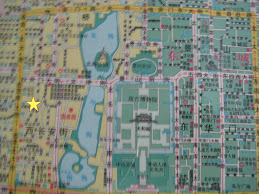
Setting aside the metaphors for a moment, I want to show you where I'm staying in Beijing relative to the 16 million other people in the city. Here's Beijing Shi (City), laid out on an uncle's ping-pong table:
Enclosed in the red square is the center of the city, which I've so poetically labeled "Heart of City." Inside that area you'll find Tiananmen, the Forbidden City, various Central Government buildings and Beihai (North Sea) Park, an imperial garden with a thousand-year history that has all the grandeur of a popular tourist attraction yet has retained the elegance of a living monument. (It was originally built for Kublai Khan, grandson of Genghis. This Kublai Khan.)
Zooming in, you can see the water of Beihai next to the Forbidden City. The east-west street indicated by the red oval is Changan Jie, which I've seen translated fairly accurately as Eternal Peace Avenue. Tianamen Square -- not to be confused with Tianamen, i.e. Gate of Heavenly Peace, which is that building with the gigantic portrait of Mao -- is just south of Changan Jie.
And now we zoom in some more... I live inside a quadrangle (in Chinese: siheyuan, meaning literally "four-sided courtyard") marked by the yellow star, within walking distance to Beihai.
Not bad, huh?
My family owns three units inside the quadrangle, which was originally built to house government officials and their families. My grandpa on my mom's side -- laoye (as opposed to yeye, which means grandfather on one's dad's side) -- who's since passed on, was a notable combatant during three wars: World War 2, the Chinese Civil War and the Korean War. It's been said that his head was worth several pieces of silver to the Japanese during WWII, as he was the leader of a guerilla platoon. Eventually he settled into office life within the Central Government, performing tasks that no one in our family can quite tell you about. "I never pressed him on that matter," my uncle (jiujiu) told me.
One of our units inside the quadrangle is currently leased out, while Jiujiu lives in a downstairs unit with his wife and twin boys, who are yearlings, and his wife's mother. I live with one of my cousins, Zhang Peng, on the fifth floor of a separate building.